
What Is Social Proof In Marketing and How It Works
Published on 2025-11-22
Ever walked past two restaurants, one with a line out the door and the other completely empty? Which one do you instinctively feel is better?
Chances are, you’d be drawn to the busy one. That gut feeling is social proof in action. It's the simple, powerful idea that we often look to what others are doing to guide our own decisions. We assume that if a lot of people are doing something, it must be the right thing to do.
In marketing, this isn't just a neat psychological trick; it's a fundamental way to build trust. Instead of just telling people your product is great, you let the actions of others—like reviews, testimonials, or even just the sheer number of users—do the talking. It’s about showing, not just telling.
What Is Social Proof and Why It Matters for Growth
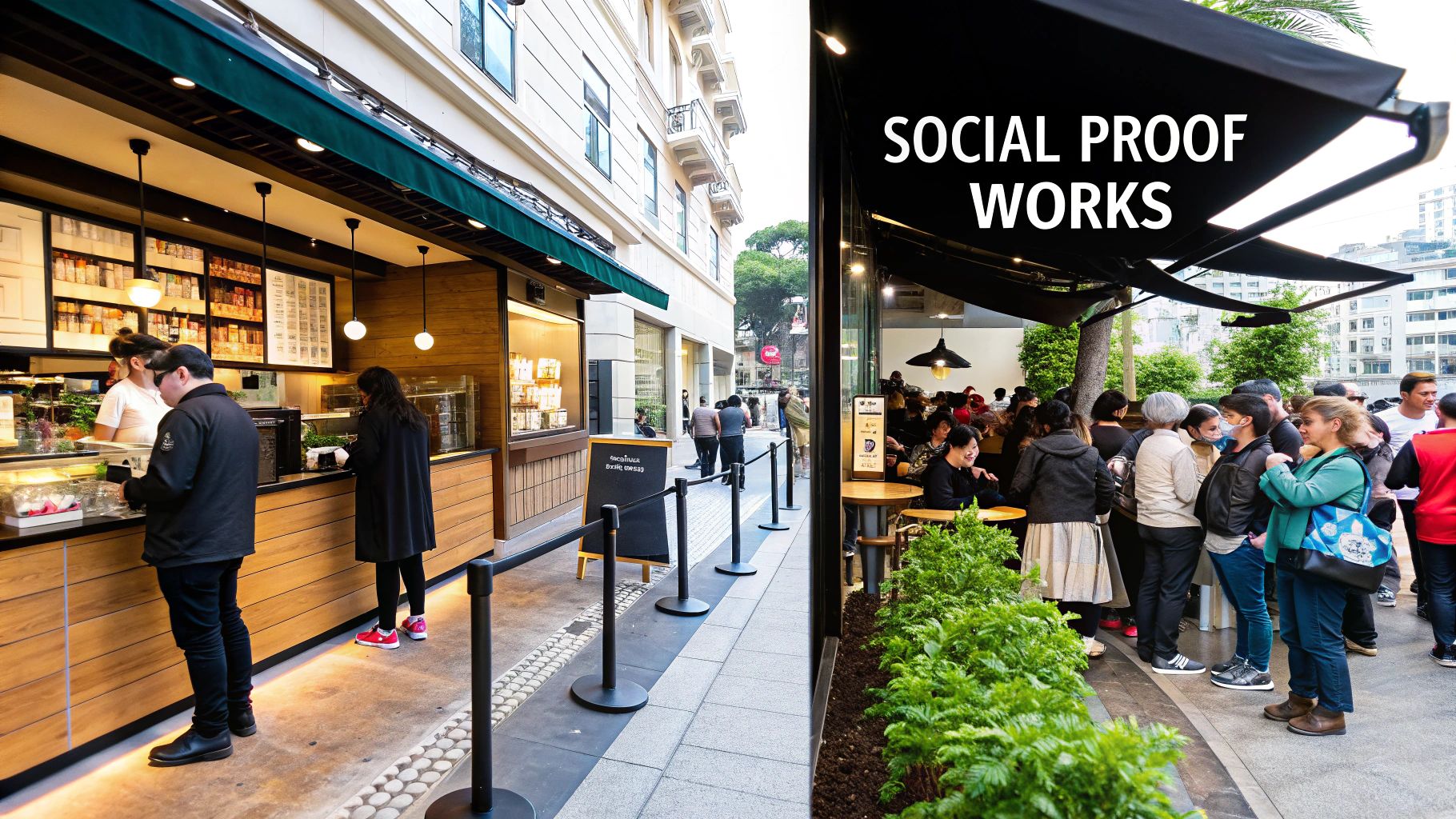
Think about it. When you're unsure about a decision, what do you do? You look for clues from other people. You check Amazon reviews before buying a product, browse Yelp before picking a dinner spot, or ask friends for recommendations. We’re hardwired to follow the herd because, historically, it’s been a good survival strategy.
That same instinct kicks in when a potential customer is considering your business. They're looking for signs that others have gone before them and had a good experience. Seeing that people already trust and value what you offer lowers their guard, reduces their sense of risk, and makes them feel much more comfortable taking the next step.
The Business Impact of Trust Signals
At its heart, social proof is all about building a collection of trust signals. These are the little cues that tell prospects, "Hey, this is a safe bet. Other people like us have tried it and loved it." In a market flooded with options, these signals are what make you stand out.
The impact on your bottom line is very real. Consider this: a staggering 92% of consumers will pause and rethink a purchase if there are no customer reviews. People depend on the experiences of others. On the other hand, businesses that consistently show off positive feedback and happy customers can see revenue jump by as much as 62% per visitor. You can dig into more numbers on the statistical impact of social proof on Datapins.com.
To really grasp how these elements work together, let's break down the core ideas.
The Core Principles of Social Proof at a Glance
This table breaks down the foundational concepts of social proof and its direct impact on consumer behavior.
| Core Principle | Psychological Driver | Business Impact |
|---|---|---|
| Uncertainty | When unsure, people look to others for guidance. | Reduces buyer hesitation and friction in the sales process. |
| Similarity | We are more influenced by people we perceive as similar to us. | Testimonials from relatable customers are highly effective. |
| Expertise | We trust endorsements from credible, knowledgeable figures. | Builds authority and credibility for your brand or product. |
| Numbers | Large numbers imply popularity and correctness ("wisdom of the crowd"). | Creates a sense of FOMO (Fear of Missing Out) and validation. |
These principles show that social proof isn't a gimmick; it's a deep-seated part of how we make choices.
Social proof isn't just another marketing tactic; it's a fundamental part of human decision-making. By showing that real people trust and benefit from your brand, you create an environment where new customers feel safe and confident enough to say "yes."
Ultimately, it works because it changes the conversation. It's no longer about what your company says about itself—it's about what your community of happy customers says for you. That kind of authentic, third-party validation is far more powerful than any ad ever could be.
Why Social Proof Actually Works: A Look Inside the Human Brain
So, what makes social proof such a powerhouse in marketing? It's not some modern-day gimmick. The secret is baked right into our DNA. We're social animals, and for millennia, our survival has depended on following the herd for safety, validation, and information.
Think about it this way: you're walking down a busy street, and suddenly a small group of people stops dead in their tracks and stares up at a building. What’s your first instinct? You look up, too. You don't even have to think about it. You just assume they've spotted something you need to know about.
That's social proof in its purest form. When we're faced with uncertainty, we instinctively look for clues from others. We want to know that someone else has gone first and that everything turned out okay. It’s a mental shortcut that helps us make faster, safer decisions.
We Trust What Others Do (Informational Social Influence)
This instinct is a psychological principle called informational social influence. It’s the idea that when we're unsure how to act, we look to the people around us for answers. It's not about caving to peer pressure; it’s about a genuine belief that the group probably knows something we don't.
So when a potential customer sees a product with thousands of five-star reviews, they're not just seeing good feedback. They're seeing a powerful signal that thousands of other people have already taken the risk and validated the decision. This instantly lowers their own perceived risk and makes the choice feel like a safe one.
This is exactly why social proof is so effective at:
- Easing Purchase Anxiety: Seeing others happy with their decision helps new buyers feel confident they won't be left with a case of buyer's remorse.
- Cutting Through Skepticism: It’s one thing for a company to sing its own praises. It's far more compelling to hear it from hundreds of real customers.
- Triggering FOMO: When something is clearly popular or selling out, our fear of missing out kicks in, pushing us to act before it's too late.
The Power of Popularity (The Bandwagon Effect)
A close cousin to this is the bandwagon effect. This is our natural tendency to do or believe something just because a lot of other people are. We're wired to want to be part of the "in-crowd" or back the winning horse. Marketers know this and often highlight a product's popularity to pull people in.
You see it all the time in phrases like:
- "Join 10,000+ happy customers!"
- "Our #1 bestselling solution."
- "Find out what everyone's talking about."
These aren't just empty stats; they're an invitation to join a thriving community. They make choosing the product feel like the smart and popular thing to do.
This isn't about manipulation. It's about aligning your message with how people naturally behave to build real confidence. When you show that others have already made the 'right' choice by picking your brand, you’re not just selling; you're offering powerful reassurance.
Once you grasp these psychological drivers, you realize that social proof is so much more than just a few testimonials. It’s a fundamental tool for communicating value, building trust, and making your customers feel completely secure in their decision to choose you. You're turning a potential risk into a sure thing.
Six Powerful Types of Social Proof You Can Use
It’s one thing to know social proof works, but it's another thing entirely to know how to use it effectively. Social proof isn't just a single tactic; think of it more like a versatile toolkit, with different tools for different jobs. Each type taps into a unique psychological trigger, whether it’s our trust in an expert or our instinct to follow the crowd.
Let’s break down the six most effective types. These are the fundamental building blocks you can use to build a powerful foundation of trust for your brand.
1. User Proof: The Voice of the Customer
This is probably the most common and relatable form of social proof out there. User proof comes straight from your current customers, showcasing their real-world experiences with your product or service. It’s so powerful because it comes from people who were once in the exact same shoes as your potential buyers.
This type includes things like:
- Customer Reviews and Ratings: Think star ratings on product pages or review sites like G2 and Capterra.
- Testimonials: Direct quotes from happy customers, often paired with a photo to really drive home the authenticity.
- Case Studies: These are the deep-dive stories that detail how a customer solved a specific problem and achieved real, measurable results with your help.
You really can't argue with the results. This all started with early online platforms like Airbnb, which had to use reviews to build trust in a totally new concept. Fast forward to today, and 63% of consumers are more likely to buy from a site that has user reviews. Even better, products with five or more reviews see their chance of being purchased jump by a staggering 270%. You can dig into more of this data on how reviews impact buyer behavior on CXL.com.
2. The Wisdom of the Crowd
Ever see a brand boast, "Join over 1 million satisfied customers"? That's the wisdom of the crowd in action. This type of social proof works on a simple idea: if tons of people are doing something, it must be the right choice.
It plays on our natural fear of missing out (FOMO) and our deep-seated instinct to follow the herd. Big numbers signal safety, popularity, and validation.
A few examples of this include:
- Displaying your total number of customers, users, or downloads.
- Showing off your social media follower counts or email subscriber numbers.
- Highlighting how many times a product has been bought or viewed that day.
Slack does this brilliantly on its homepage by displaying the logos of major companies that use its platform. The unspoken message is clear: if it’s trusted by the best, it’s a safe bet for you, too.
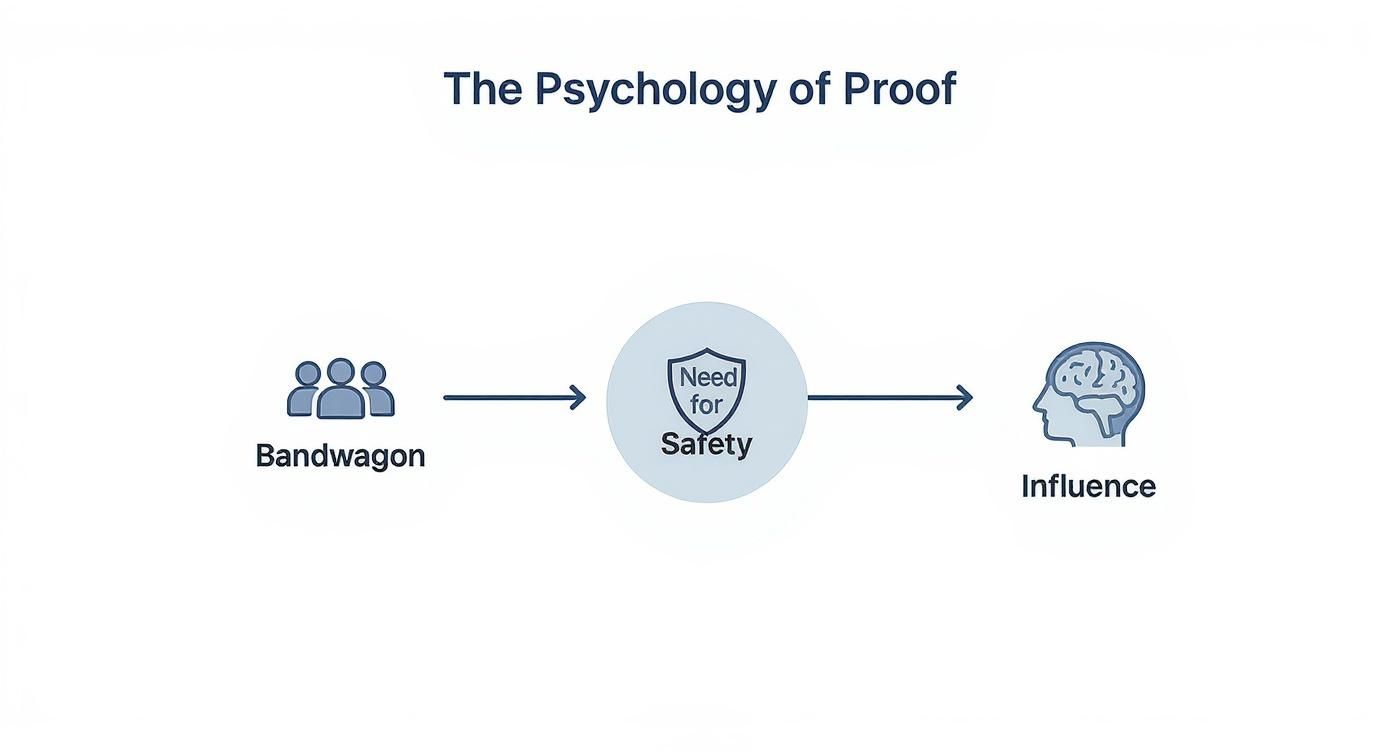
This image nails it. Seeing a crowd's actions (the bandwagon effect) taps directly into our core need for security, which ultimately influences what we decide to do.
3. Expert Social Proof
When a recognized authority figure or an industry expert gives your product a thumbs-up, their credibility essentially rubs off on you. That’s expert social proof, and it’s an incredible way to lower the perceived risk for a new customer. We trust experts because we assume they’ve already done the homework for us.
This kind of validation is gold, especially for B2B companies or in highly technical fields. When you build a reputation as a credible voice, you're practicing what is thought leadership, and that’s a magnet for high-quality leads.
Expert proof often looks like:
- An endorsement from a well-known industry influencer.
- A glowing review in a respected publication or on a popular blog.
- Showcasing the impressive credentials or qualifications of your team members.
4. Celebrity Endorsement
Similar to expert proof, a celebrity endorsement uses the influence of a famous person to make a brand more appealing. But where an expert offers deep credibility, a celebrity brings aspiration and massive visibility to the table. People admire celebrities, so their recommendations carry a lot of weight.
This is a classic marketing play we see everywhere, from Nike’s legendary partnership with Michael Jordan to George Clooney’s long-standing association with Nespresso. The trick is to find a celebrity whose personal brand and audience genuinely align with your product.
5. Certifications and Awards
Trust badges, industry awards, and official certifications are a quick, visual form of social proof. They work like a mental shortcut, instantly telling people that a neutral third party has vetted and approved your business.
These symbols tell a potential customer, "We meet a high standard of quality, security, and excellence." It’s an objective stamp of approval that you simply can’t give yourself.
This includes things like:
- Displaying security badges like "SSL Secured."
- Showcasing awards like "G2 High Performer" or "Best Place to Work."
- Mentioning accreditations from official industry bodies.
6. Social Media Signals
In our hyper-connected world, a brand’s social media presence is a living, breathing form of social proof. High follower counts, a ton of engagement on posts (likes, shares, comments), and mentions from other users all build up your credibility.
When a potential customer lands on your LinkedIn or Instagram page and sees a vibrant, engaged community, it sends a powerful message: people care about this brand. It shows you’re relevant, active, and trusted by many.
A Step-By-Step Guide to Implementing Social Proof
Knowing the types of social proof is one thing. Actually putting them to work to get results? That’s a whole different ballgame. An effective strategy is so much more than just sprinkling a few testimonials on your site. It’s a thoughtful process of finding, gathering, placing, and measuring the trust signals that matter most to your audience.
This guide breaks that process down into four clear, actionable steps. Follow these, and you’ll have a solid framework for turning happy customers into your most powerful growth engine. Let's move from theory to action.
Step 1: Identify the Right Social Proof for Your Audience
Not all social proof hits the same. The best kind for you depends entirely on your product, your industry, and most importantly, your specific audience. A B2B software company will probably get more traction from a detailed case study, whereas a fashion brand might see huge success with user-generated content from Instagram.
Start by asking yourself a few simple questions:
- What are our customers’ biggest doubts? If price is the main hurdle, testimonials focused on ROI are your best friend. If it’s product complexity, an expert endorsement can build the confidence they need.
- Where do they go for information? If they're buried in industry blogs, a glowing review from a well-known expert is gold. If they trust their peers above all else, user reviews are what you need.
- Who do they really trust? Is it industry titans, celebrities, or just people like them? The answer points you directly to the right kind of proof.
Answering these helps you stop guessing and start collecting the signals that will actually connect with your prospects and dismantle their objections.
Step 2: Create Systems for Collecting Feedback
Authentic social proof doesn’t just fall out of the sky. You need a system to actively go out and get it. The trick is to make it incredibly easy for happy customers to share their stories. If it feels like a chore, they just won't do it.
Set up simple, automated systems to keep a steady flow of feedback coming in. For instance, you could trigger an automated email to go out a week after a purchase, asking for a quick review. Or, you could build a simple form on your website where customers can submit testimonials whenever they feel inspired.
And remember, social proof isn't just reviews. It's also raw numbers, like how many followers you have or how many products you've sold. In fact, 79% of people say user-generated content (UGC) heavily influences their buying decisions. It's no surprise that websites featuring UGC see a 29% higher web conversion rate—it just feels more real and trustworthy. Shopify.com has some great insights on using social proof to boost sales.
Step 3: Strategically Place Your Social Proof
Once you've got a great collection of testimonials, reviews, and data points, where you put them is just as important as what they say. Placing social proof in the right spots can make a huge difference. The goal is to show them the right trust signal at the exact moment they’re feeling a bit of hesitation.
Here are a few high-impact places to start:
- Homepage: Put your strongest testimonials or big-name client logos right up front to make an immediate, powerful impression.
- Product/Service Pages: Position relevant reviews and star ratings right next to your product descriptions and "Add to Cart" buttons.
- Pricing Page: This is the perfect spot for case studies or ROI-focused testimonials that justify the cost and ease any sticker shock.
- Checkout Flow: A few well-placed trust badges or a simple "Join X happy customers" message can be surprisingly effective at reducing cart abandonment.
The words you use to frame your social proof matter, too. You can learn more about how to nail your copy in our guide on persuasive writing techniques.
Key Takeaway: The goal is to anticipate a user’s hesitation and provide a perfectly timed piece of social proof to resolve it. Don't make them hunt for it; put it right where their doubts are likely to surface.
Step 4: Measure and Refine Your Strategy
Finally, using social proof isn't a one-and-done task. To know what's really working, you have to track the impact. By keeping an eye on a few key metrics, you can fine-tune your approach over time and get even better results.
Start by monitoring metrics like:
- Conversion Rate: Run A/B tests on pages with and without social proof. Do pages with testimonials actually convert better?
- Time on Page: Are visitors who read your case studies sticking around on your site longer? That's a great sign of engagement.
- Click-Through Rate (CTR): Do calls-to-action placed next to trust badges get more clicks?
This data will give you clear, undeniable proof of what's making the biggest difference. From there, you can double down on what works and make your entire strategy that much stronger.
How to Showcase Social Proof on Your Website

Collecting all that great social proof is just the first step. The real magic happens when you show it off in the right way, at the right time. Tucking all your best testimonials away on a single page just won't cut it; you need to sprinkle these trust signals throughout your site where they'll make the biggest difference.
Think of it this way: you want to anticipate your customer's doubts and have the perfect piece of reassurance ready to go at that exact moment. When you get this right, your website transforms from a static digital brochure into a powerful conversion machine. It's all about weaving proof into the user's journey so smoothly that it guides them toward a decision without ever feeling like a hard sell.
Let’s dig into the smartest ways to display what is social proof in marketing on your website, turning curious visitors into confident customers.
Integrate Testimonials at Key Decision Points
Your best customer quotes are far too valuable to be hidden. Place them right next to the actions you want people to take. It’s like having a trusted friend whisper, "Go for it!" just when they're about to make a choice.
Here are a few high-impact spots to consider:
- Next to Call-to-Action (CTA) Buttons: A glowing review right beside your "Request a Demo" or "Start Free Trial" button can be the final push someone needs to click.
- On Product Pages: Feature reviews that talk about the specific benefits or features of that exact product. This makes the proof highly relevant.
- On Your Pricing Page: This is often where people get hesitant. You can ease their concerns with testimonials that emphasize the incredible value, the return on investment (ROI), or how the price is a bargain for the results they’ll get.
Imagine a quote like, "This tool saved our team 10 hours a week," sitting right on your pricing page. Suddenly, the cost isn't just an expense; it's a smart investment.
Build Instant Credibility with Logos and Badges
Visuals work fast. When someone lands on your site, they form an impression in seconds. Logos from well-known clients, media features, and industry awards are powerful shortcuts to earning their trust.
These visual cues are an immediate stamp of approval. They communicate, "If these respected brands trust us, you can too." This is a game-changer, especially for B2B companies trying to prove their authority.
Put these visuals where they can’t be missed:
- Homepage "As Seen In" Bar: A simple row of logos from media outlets that have featured you.
- Footer Trust Badges: Security seals, logos from payment providers like Visa or PayPal, and any industry certifications.
- Dedicated Client Logo Section: Show off the logos of your most impressive customers to prove you're a serious player in the market.
This kind of visual reinforcement makes your business look professional and reduces a visitor's sense of risk before they even read a single word of your copy.
Create Urgency with Real-Time Activity
One of the most powerful forms of social proof is showing people what’s happening on your site right now. This taps into the "wisdom of the crowd" and creates a natural sense of FOMO (Fear of Missing Out), nudging visitors to take action.
You can do this with a few simple but effective tools:
- Live Sales Notifications: Small pop-ups that say things like, "Jane from New York just purchased Product X."
- "Users Viewing" Counters: A little note on a product page that says, "15 people are currently looking at this item."
- Recent Activity Feeds: A running list of recent sign-ups or purchases, which shows that your business is active and growing.
These real-time updates make your website feel like a popular, bustling marketplace instead of a quiet, empty store. It signals that your products are in demand, which makes them that much more appealing. When visitors see others buying, it feels safer and more compelling for them to do the same. This is a simple but incredibly effective way to drive immediate conversions.
Building Authentic Trust with Your Audience
As we've walked through the different kinds of social proof, let's bring it all back to what really matters: building genuine, lasting trust. The point isn't to fake popularity or pull a fast one on your audience. Real social proof is the honest result of a fantastic customer experience, not some manufactured illusion.
Sure, you can buy fake reviews or pump up your user numbers. But while those tactics might give you a quick, temporary lift, they always backfire. Today’s customers are smart—they can sniff out inauthenticity a mile away. When you get caught, you don't just lose a little credibility. You obliterate the very trust you were trying to earn, causing permanent damage to your brand.
The Foundation of Real Connection
The most potent social proof isn't a clever marketing trick. It's the natural outcome of doing great work and building positive relationships. Authentic testimonials, real user-generated content, and honest case studies lay a foundation of credibility that simply can't be faked. This is how you turn happy customers into your most powerful advocates.
When you focus on genuine connection, you're setting yourself up for sustainable growth. To dive deeper into building those bonds, check out our guide on customer engagement best practices.
The ultimate goal is to create a customer experience so positive that social proof becomes an organic byproduct. When people genuinely love what you do, they will want to share it.
Your Actionable Next Step
Okay, let's turn theory into practice. Don't just read about this stuff—put it into action this week. I have a simple challenge for you.
- Review the six types of social proof we covered (User, Crowd, Expert, Celebrity, Certifications, and Social Media).
- Identify just one type that feels doable for you right now. No need to overthink it.
- Create a simple plan to start collecting it. It could be as easy as emailing three of your happiest clients and asking for a quick testimonial.
By taking this one small, concrete step, you're starting to use social proof as it was intended: not just as a tactic, but as a tool for authentic connection and real, long-term business growth.
Frequently Asked Questions About Social Proof
When you're starting to use social proof, a few common questions always seem to pop up. Let's tackle them head-on so you can put these ideas into practice with confidence.
How Can a New Business with No Customers Get Social Proof?
This feels like a classic chicken-or-the-egg problem, right? But you don't need a massive customer base to start building credibility. There are a few clever ways to get the ball rolling.
A great first move is to offer your product or service to a small group of beta testers. You can give it to them for free or at a steep discount in exchange for honest feedback and a testimonial. Just like that, you have your first pieces of genuine user proof.
Beyond that, you can lean on other types of validation:
- Expert Proof: Find a respected expert in your industry and ask them to review your product. Their stamp of approval can give your new venture immediate authority.
- Founder Proof: Don't forget to showcase the expertise of your founding team. If your leaders have a solid track record, that experience is a powerful trust signal on its own.
- Crowd Wisdom (on a smaller scale): Start building an engaged community on social media. Even if your following is small, high engagement, thoughtful comments, and shares on your posts show that people are paying attention.
Is It Okay to Use Negative Reviews as Social Proof?
It sounds counterintuitive, but yes—absolutely. A few less-than-perfect reviews can actually make you look more credible. Think about it: when you see a product with thousands of flawless 5-star ratings, doesn't a small part of you get a little suspicious?
Having a mix of 4-star and even 3-star reviews signals transparency. It makes your glowing reviews feel more authentic and earned. The real magic isn't in the negative review itself, but in how you respond.
A public, professional response to a complaint is a masterclass in customer service. It shows potential customers that you listen, you care, and you’re committed to getting it right—and that can be far more convincing than a perfect record.
What Is the Difference Between Social Proof and a Case Study?
It helps to think of it like this: a case study is one specific form of social proof, but the concept of social proof is much bigger.
Social proof is the general psychological principle that we look to others to guide our own behavior. It can be as simple as a star rating, a "10,000 downloads" badge, or a celebrity shout-out.
A case study, however, is a deep dive. It’s a detailed story that walks through how a specific customer overcame a challenge and achieved real, measurable results using your product. It’s got a clear beginning, middle, and end, packed with data and a compelling narrative. It's one of the most powerful and persuasive forms of user proof you can create.
How Often Should I Update the Social Proof on My Website?
There’s no single right answer here—it really depends on the type of proof and how fast your business is moving. For things like customer testimonials and reviews, freshness matters. Try to add new ones at least once a month to show your business is active and people are still loving what you do. A testimonial from 2018 just doesn't hit the same.
For "wisdom of the crowd" metrics, like your total number of customers served, update them whenever you hit a new, impressive milestone. The goal is to paint a picture of constant momentum. If you can, automating the collection and display of new reviews is the best way to keep everything feeling current and relevant without extra work.
Ready to build powerful social proof for your own outreach? With Unibox, you can automate LinkedIn and email sequences to connect with more prospects, then manage every conversation in one central inbox. Start your free 14-day trial and see how easy it is to book more meetings. Learn more about Unibox.