Discover what is professional writing and its impact
Published on 2025-12-01
Let's be honest, "professional writing" sounds a bit stuffy. But it's really just about writing that gets a job done. Think of it as communication with a clear purpose, designed to hit a specific business goal.
This isn't writing for the sake of writing. It's writing that does something—whether that's informing your team, persuading a client, or guiding a user. It’s less like a personal diary and more like an architect's blueprint: every single part is there for a reason, built with a specific audience and outcome in mind.
What Professional Writing Really Means

At its heart, professional writing is a practical tool. That tool might be used to get everyone on the same page with a project update, convince a customer to click "buy," or show someone how to assemble a flat-pack desk without tears. The goal is always tangible.
This is where it parts ways with creative or academic writing. Those styles often prioritize self-expression or exploring complex theories. Professional writing, on the other hand, is relentlessly pragmatic. Every word has a job, and every sentence is built to move the reader one step closer to a specific action or understanding. This goal-oriented nature is what makes it unique.
The 3 Pillars Holding It All Up
To get a real feel for what makes professional writing work, you can break it down into three core ideas. These are the foundations of any effective piece of business communication.
- It’s All About the Audience: Great professional writers always start by asking, "Who am I talking to?" Knowing your audience’s background, what they need, and what questions they might have is the key to crafting a message that actually lands.
- Clarity is King: There's no time for confusion. The language needs to be direct, simple, and to the point. Ditch the jargon and fluff—the goal is for your message to be understood on the first read.
- Structure with a Purpose: Every document has an objective, and its structure should be a roadmap leading the reader straight to it. That could mean a logical, step-by-step flow in a report or a persuasive story arc in a sales email.
The product of your writing time is YOU. Not the novel, not the short story–you. The person you become through the process of writing, the empathy you develop, the voice you discover.
This idea fits perfectly in the business world, too. When you improve your professional writing skills definition, you’re not just getting better at words; you're becoming a more effective communicator, a sharper thinker, and a better strategist.
How It Stacks Up Against Other Writing Styles
Sometimes the easiest way to understand what something is is to look at what it isn't. When you place professional writing next to its academic and creative cousins, its unique role becomes crystal clear.
Here’s a quick breakdown of how they differ.
Professional Writing vs Other Writing Styles
| Attribute | Professional Writing | Academic Writing | Creative Writing |
|---|---|---|---|
| Primary Goal | To inform, persuade, or instruct for a business outcome. | To analyze, argue, and contribute to scholarly knowledge. | To entertain, evoke emotion, and explore human experience. |
| Audience | Specific (clients, colleagues, managers). | Niche (scholars, researchers, students). | General or specific (readers, fans). |
| Tone | Objective, clear, direct, and adaptable to context. | Formal, analytical, and evidence-based. | Expressive, imaginative, and artistic. |
As you can see, professional writing is built for a world of action and results. Its focus on a specific audience, a clear goal, and a direct tone is what sets it apart and makes it such a vital skill in any industry.
The Five Core Types of Professional Writing
Professional writing isn't a single skill—it’s more like a toolbox. You wouldn't use a hammer to saw a board, and you wouldn't use a technical manual to write a catchy ad. Knowing what is professional writing is really about understanding its different forms and picking the right tool for the job.
The report you send to your boss and the social media post you scroll past are worlds apart in style, but both are crafted with a specific goal in mind. Each type of professional writing has its own audience, purpose, and rules of engagement. Getting good at just one of them can open up some incredible career doors.
Let's break down the five big ones you'll run into most often.

1. Business Writing
Think of business writing as the central nervous system of a company. It’s all about communicating information clearly and efficiently inside the organization—to your team, your boss, or another department. This writing is built for clarity, conciseness, and action. It’s the stuff that keeps the gears turning.
The goal isn't to be poetic; it's to get things done. It needs to be direct and impossible to misunderstand, because one confusing email can throw a whole project off track. From a quick memo to a detailed proposal, good business writing is what drives decisions and keeps everyone aligned.
If you're looking to sharpen your skills here, focusing on structure and getting straight to the point is the way to go. You can find more great advice in our collection of practical business writing tips.
Common Examples:
- Emails: The daily currency of requests, updates, and coordination.
- Memos: Formal announcements or directives for internal teams.
- Reports: In-depth documents on performance, project status, or financial results.
- Proposals: Persuasive documents making a case for a new project or idea.
2. Technical Writing
If business writing is the nervous system, technical writing is the user manual. This is all about taking complex, specialized information and making it easy for anyone to understand. The whole point is to guide someone through a process, explain how something works, or document a complicated system.
Here, accuracy and clarity are everything. A great user guide makes a customer happy and self-sufficient. A bad one creates frustration and floods your support team with tickets. Technical writers are essentially translators, turning jargon and dense engineering-speak into simple, step-by-step instructions.
The core of technical writing is empathy. It’s the ability to put yourself in the user’s shoes and anticipate their questions, their confusion, and their need for a clear, logical path forward.
It’s not just about writing well; it’s about thinking logically and organizing information so that users can find exactly what they need, right when they need it.
3. Copywriting
Copywriting is writing that sells. It’s the art and science of persuasion, crafted with one goal in mind: getting the reader to take a specific action. That action could be buying a product, signing up for a newsletter, or booking a demo. This is the writing you see in ads, on websites, and in marketing emails.
Unlike other forms of professional writing, which often stick to the facts, copywriting dives headfirst into emotion. A good copywriter gets inside the head of their audience to understand their biggest problems and deepest desires. They then craft a message that connects on a personal level, showing the reader exactly how a product or service will make their life better.
- Key Focus: Persuasion and conversion.
- Tone: Engaging, emotional, and benefit-focused.
- Audience: Potential customers and clients.
Great copywriting is measured in results. Did the ad get clicks? Did the landing page get sign-ups? This direct link to the bottom line makes it one of the most valuable skills in business.
4. Editorial Writing
Often called content writing, editorial writing is about building relationships by providing value. Instead of going for the direct sale, its purpose is to inform, educate, or entertain. We’re talking about blog posts, articles, and white papers that establish a brand as an expert in its field.
While copywriting wants a quick "yes," editorial writing is playing the long game. The aim is to create a loyal audience by consistently publishing helpful and interesting content. For instance, a tech company might write articles about industry trends to show they know their stuff. Over time, this builds trust, so when a reader is finally ready to make a purchase, that company is the first one they think of.
5. Social Media Writing
Social media writing is a special hybrid, mixing the persuasion of copywriting with the relationship-building of editorial—all packed into a tiny, fast-moving package. It’s writing that’s built for platforms like LinkedIn, X (formerly Twitter), and Instagram, where you have seconds to grab someone's attention.
A great social media writer is a master of the scroll-stop. They use a conversational tone, eye-catching visuals, and questions to spark conversations and build a community. Every single post is a miniature campaign, designed to connect with people in a way that feels authentic and immediate.
Mastering the Essential Professional Writing Skills

Knowing the different types of professional writing is one thing, but actually creating work that gets results? That comes down to a specific set of skills. We're not talking about having a huge vocabulary or writing fancy, complicated prose. It’s all about the practical, non-negotiable abilities that make your words count.
Think of it like being a chef. You can know the difference between baking and grilling, but that doesn't mean you can run a kitchen. To really succeed, you need to master the fundamentals—knife skills, temperature control, and how to balance flavors. It's the same for writers. You need a core set of skills to consistently deliver effective communication.
Let’s break down that checklist. This is your guide to figuring out where you shine and where you can sharpen your skills for the biggest impact.
Achieving Crystal-Clear Clarity
If there’s one skill that stands above all others, it’s clarity. Plain and simple. If your reader has to go back and reread a sentence to figure out what you mean, you've already lost them. Your goal should be to make your message so direct and easy to follow that it's impossible to misinterpret.
The best way to get there is by embracing plain language. That just means choosing simple, direct words over complicated jargon. Instead of "utilize," just say "use." It's about getting your point across in the most straightforward way possible.
This isn't about "dumbing down" your content. It's about making it accessible. When information is easy to digest, it's more powerful.
Here are a few quick ways to instantly improve clarity:
- Use Active Voice: "Sarah wrote the report" is much more direct than "The report was written by Sarah." It's punchier and clearer.
- Keep Sentences Short: Long, winding sentences make readers work too hard. Aim for an average of 15-20 words to keep things moving.
- One Idea Per Paragraph: This simple rule helps you structure your thoughts and guides the reader smoothly from one point to the next.
Understanding and Analyzing Your Audience
Great writing always starts with the same question: "Who is this for?" Before you type a single word, you have to get inside your audience's head. A report for a C-suite executive will be wildly different from a welcome email to a new customer.
Audience analysis is all about understanding:
- Their Knowledge Level: Are they experts or complete beginners? This tells you how much context you need to give them.
- Their Goals: What problem are they trying to solve? What information do they need to make a decision or take the next step?
- Their Pain Points: What frustrates them? If you can speak directly to their challenges, your writing will feel instantly more relevant and valuable.
"The product of your writing time is YOU. Not the novel, not the short story–you. The person you become through the process of writing, the empathy you develop, the voice you discover."
This idea is spot-on for audience analysis. When you put yourself in your reader’s shoes, you build the empathy required to write something that truly connects with them. This is just one of many essential writing skills examples that separate good writers from truly great ones.
Adapting Tone and Style
Finally, a skilled writer knows how to switch gears. The tone you use in a formal annual report is nothing like the friendly, conversational style of a social media update. The ability to move between these different voices is what makes a professional writer so valuable.
The freelance writing world is booming for a reason. With nearly 80 million freelancers expected in the US by 2025 and 75% of large companies outsourcing writing, the demand is huge. Businesses need writers who can adapt their style to fit any niche, from dense tech manuals to catchy marketing copy. Versatility is the name of the game.
To get this right, always think about the context and the platform. Is this a formal email or a quick Slack message? A detailed white paper or a punchy tweet? Matching your tone to the situation is how you build credibility and make sure your message lands exactly as you intended.
Let's Put Your Writing Skills to Work
Theory is one thing, but the real test is seeing how these skills perform in the wild. And what better place to do that than on LinkedIn? Think of your LinkedIn profile as a living, breathing portfolio. Every single word you write—from your "About" section to a simple comment—is a piece of professional writing that builds your personal brand.
It's time to move from abstract ideas to concrete, practical examples. We're going to break down three of the most common pieces of writing on LinkedIn: the 'About' section, the connection request, and the everyday post. I'll show you exactly why they work, so you can turn these principles into your own playbook.
Crafting a Compelling LinkedIn About Section
Your 'About' section isn't just a digital resume; it's your professional story. A great one grabs the reader's attention right away, clearly explains the value you bring, and does it in a way that connects with their goals. It’s a perfect mix of storytelling and sharp business communication.
Here’s an example for a fictional marketing manager.
"For over 8 years, I’ve been obsessed with one question: how do you turn a casual browser into a loyal fan? My journey has taken me from a scrappy B2B SaaS startup to leading a fantastic team at a Fortune 500 company, where we boosted organic lead generation by 45% in a single year.
I build data-driven content strategies that do more than just get clicks—they build trust. My core skills are in SEO, content marketing, and team leadership, and I love nothing more than mentoring other marketers and creating systems where creativity and performance go hand-in-hand.
If you're building a marketing engine that drives real growth, let's connect. I'm always up for a good conversation about new strategies."
Why This Works:
- A Strong Hook: It kicks off with a question, pulling the reader into the story immediately.
- Real, Quantifiable Results: That 45% increase isn't just a number; it's concrete proof of what they can do. Results speak louder than buzzwords.
- Clear Expertise: It names specific skills (SEO, content marketing), so recruiters and potential connections know exactly what they're getting.
- An Open Invitation: The final paragraph is a clear and friendly call-to-action (CTA), making it easy for people to take the next step.
Writing a Connection Request That Actually Gets Accepted
We all get those generic connection requests, and most of us hit "ignore." A personalized note, on the other hand, shows you've actually paid attention and have a good reason for reaching out. This is professional writing in miniature, where every word has a job to do.
Here’s a simple template for connecting with someone you admire in your field:
"Hi [Name],
I really enjoyed your recent post on the future of AI in sales. Your point about human oversight being the secret ingredient for success really hit home.
As someone working in sales development, I'm always looking to learn from leaders like you. I'd love to connect and follow your work.
Best, [Your Name]"
This little message works wonders because it's specific, genuinely complimentary, and respects their time. It builds an immediate bridge by establishing common ground and gives a clear, no-pressure reason for the request.
Creating a Post That Establishes Your Authority
Finally, let's break down a post designed to showcase expertise. Good writing on LinkedIn isn't about just sharing an article link; it's about starting a meaningful conversation and offering a perspective that only you can provide.
Think about structuring your next thought-leadership post like this:
The Hook: "Most companies are getting customer feedback all wrong. They ask customers what they want, but they rarely dig into the why."
The Core Insight: "I've learned that the best insights don't come from surveys. They come from short, 15-minute 'problem-focused' interviews. Instead of asking for a feature wish list, we ask: 'What was the single hardest part of your workflow last week?' This simple shift changes the entire conversation from features to root problems—and that's where the real innovation is hiding."
The Actionable Takeaway: "Next time you’re looking for feedback, just try asking one problem-focused question. The ideas you'll uncover will surprise you."
The Call to Engage: "What’s one clever way you’ve gathered powerful customer feedback? Drop your ideas in the comments!"
This post is a scroll-stopper. It uses a strong opener, delivers a genuinely useful insight, and wraps up with a question that invites others to join the discussion. It’s professional writing perfectly built for a social platform—it's concise, valuable, and designed to connect.
How to Create and Measure Effective Writing
Great professional writing doesn't just happen by accident. It’s the result of a deliberate process that starts long before you type the first word and continues well after you hit "publish." It’s an engineered approach that turns abstract ideas into clear, measurable results.
Think of it like building a bridge. You wouldn't just start laying bricks and hope for the best, right? You need a blueprint. You have to know who is crossing (your audience), where they’re going (the purpose), and the safest, most direct path to get them there (your key message). This foundational work ensures your writing is built on a solid strategy, not just wishful thinking.
Engineering Your Writing for Success
The best writers I know don’t rely on random bursts of inspiration. They follow a structured workflow to transform a simple brief into a polished piece of communication. Each step builds on the last, ensuring the final product is both high-quality and laser-focused on its goal.
Having a repeatable framework is your best asset. Here’s a simple but effective one I use all the time:
- Deconstruct the Brief: First, get crystal clear on the objective. Who are you writing for? What specific action do you want them to take? What's the one single idea they absolutely must walk away with?
- Outline and Structure: Before you even think about writing full sentences, create a logical skeleton. This outline is your roadmap, making sure your arguments flow smoothly and build toward a powerful conclusion.
- Draft with a Focus: Now it's time to write. Get the first draft down quickly, focusing only on getting your ideas onto the page. Don't stress about perfection here—the goal is to create the raw material you'll refine later.
- Revise and Refine: This is where the real magic happens. Step away for a bit, then come back with fresh eyes to edit for clarity, tone, and impact. Cut every unnecessary word, strengthen your verbs, and make sure every single sentence serves the primary goal.
Effective writing is about more than just words on a page; it’s about creating an experience that guides the reader from one point to the next, effortlessly. The real work is in the revision process, where you trim the fat and clarify the message until it’s impossible to ignore.
This is especially true on a platform like LinkedIn, where every piece of writing—from your profile to your posts—works together. The process moves from establishing who you are to making a connection and then sharing valuable content.
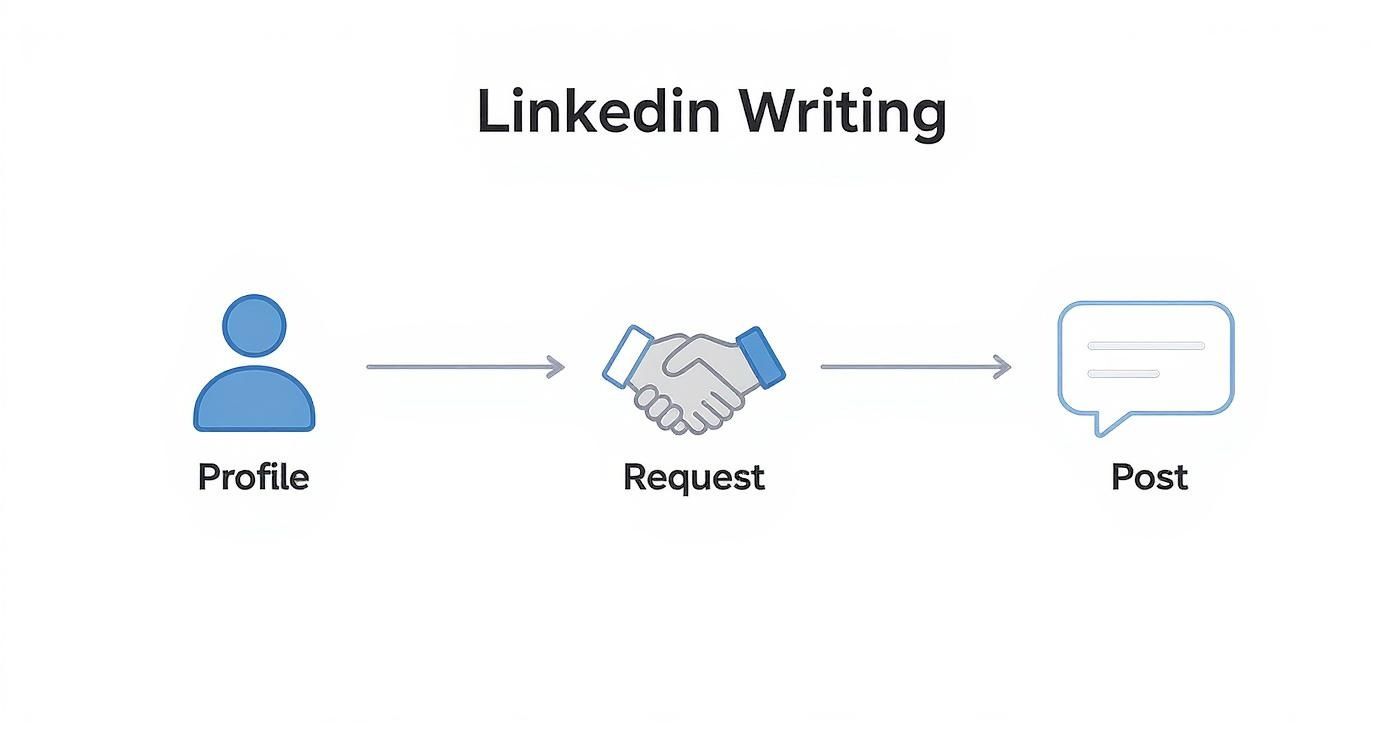
This flow shows how your profile, connection requests, and posts all combine to build your professional brand and help you hit your networking goals.
Measuring What Matters Most
Once your writing is out in the world, your job isn't over. The final, critical step is to measure its effectiveness. After all, professional writing is a tool for achieving business outcomes. You need to track key performance indicators (KPIs) to understand what’s working and what isn’t.
The right metrics depend entirely on what you wrote. For example:
- For a blog post: You'll want to watch the engagement rate (likes, comments, shares), time on page, and organic traffic. These numbers tell you if you’re actually capturing and holding your audience's attention.
- For a sales email: The most important metric is the reply rate or click-through rate (CTR). Did your message persuade someone to take the next step?
- For a landing page: The ultimate KPI is the conversion rate. How many visitors actually completed the desired action, like signing up for a demo or making a purchase?
This is where you can get a lot of help from modern AI tools like autoghostwriter. These assistants can help brainstorm ideas, check for clarity, and even analyze performance data. They free you up to focus less on just writing and more on delivering tangible, measurable value.
To make this clearer, let's break down the key success metrics for different types of writing.
Measuring Writing Success: Key Metrics By Type
The table below outlines the primary success metrics used to evaluate the effectiveness of different types of professional writing.
| Writing Type | Primary Metric | Secondary Metrics |
|---|---|---|
| Business Writing (Reports, Memos) | Action Taken | Clarity Score, Time to Completion |
| Technical Writing (Manuals, Guides) | User Success Rate | Support Ticket Reduction, User Feedback |
| Copywriting (Ads, Landing Pages) | Conversion Rate | Click-Through Rate (CTR), Cost Per Acquisition (CPA) |
| Editorial Content (Blogs, Articles) | Engagement Rate | Time on Page, Shares, Organic Traffic |
| Social Media (Posts, Updates) | Reach & Impressions | Engagement Rate, Follower Growth, Website Clicks |
By tracking the right numbers, you turn writing from an art into a science, allowing you to consistently refine your approach and improve your results over time.
What Can You Do With Professional Writing Skills?
Let's get down to brass tacks: learning to write professionally isn't just a "nice-to-have" skill. It's a ticket to a real, rewarding career. Companies are always on the lookout for people who can communicate clearly because it directly impacts their bottom line—think better marketing, smoother internal operations, and a brand voice that actually connects with customers.
This isn't a niche field, either. The need for sharp writers has created a thriving job market. You can find opportunities as a full-time employee, diving deep into one company's world, or as a freelancer, enjoying the variety and flexibility of working with different clients.
The Paycheck and the Potential
So, how much is this skill actually worth? Businesses put a high value on good writing, and the salaries reflect that. Whether you’re on a company payroll or billing clients directly, professional writers earn a solid living.
If you're on the fence about pursuing this, consider this: mastering professional writing is one of the smartest career moves you can make. It offers both stability and a clear path for growth.
The numbers back this up. The U.S. Bureau of Labor Statistics reported a median annual wage of $72,270 for writers and authors as of May 2024. For those who go the freelance route, the average in the U.S. lands around $63,213 a year.
Better yet, the field is growing. Projections show a 4% increase in jobs for writers between 2024 and 2034. That translates to roughly 13,400 new openings popping up each year. You can dive deeper into writing salaries and statistics to see the full picture.
This consistent growth points to a simple truth: businesses need skilled writers for everything. We're talking technical manuals, marketing emails, internal reports, social media posts—you name it. By mastering professional writing, you're not just learning to write well; you're building a versatile skill set that’s in high demand across a huge range of industries.
Got Questions? We've Got Answers
Stepping into the world of professional writing can feel like learning a new language. Let's tackle some of the most common questions to clear things up and get you writing with confidence.
What's the Real Difference Between Academic and Professional Writing?
It all comes down to purpose.
Think of academic writing as a deep dive into a complex topic. It's built to explore theories and prove an argument to a small circle of experts. The focus is on showing your work and adding to a scholarly conversation.
Professional writing, on the other hand, is all about getting something done. Its job is to inform, persuade, or teach a specific audience to drive a business goal. You're not trying to sound smart with big words; you're trying to be understood so people can take action.
At the end of the day, a professional writer is always asking, "What do I need my reader to know, feel, or do after this?" That focus on results is the single biggest thing that defines what professional writing is and sets it apart.
How Can I Start Getting Better at This, Like, Right Now?
You don't need to sign up for a fancy course. The best way to start is surprisingly simple: practice rewriting.
Grab something you've already written—an old email, a clunky paragraph from a report, anything. Now, rewrite it with one goal: make it clearer and shorter.
- Slash and burn: Hunt down every unnecessary word. Can you say it more directly?
- Go active: Flip passive sentences around. Instead of "The report was finished by the team," write "The team finished the report." It's stronger.
- Ditch the jargon: Swap out corporate-speak for simple words everyone understands.
Making this a regular habit is like a workout for your writing muscles. It trains your brain to prioritize clarity and impact above everything else.
Are AI Writing Tools a Friend or Foe?
They're a tool—and a powerful one at that. Think of an AI assistant as a junior partner, not a replacement for your brain.
AI is fantastic for the heavy lifting. It can whip up a first draft, generate an outline from a few bullet points, or summarize dense research in a flash. This saves you a ton of time.
But AI can't replicate human strategy, empathy, or the subtle nuances that make a message truly connect with a reader. The best writers use AI to handle the tedious parts, which frees them up to focus on what really matters: the high-level thinking, tone, and strategy that make the writing effective.
Ready to see what clear, purposeful writing can do for you? Unibox combines smart automation with AI assistance to help you scale your outreach on LinkedIn and email. Start your free 14-day trial and find out how better writing can book you more meetings.