What Is AI Copywriting Explained Simply
Published on 2025-11-28
So, what exactly is AI copywriting? Think of it less as a robot taking over your job and more as a super-smart creative assistant. It's technology that uses artificial intelligence to help you draft, polish, and create written content on a massive scale.
Your Introduction to AI Copywriting
At its heart, AI copywriting uses complex algorithms to get the job done. These tools have been trained on an incredible amount of text from across the internet, allowing them to recognize everything from language patterns and writing styles to sentence structures.
When you give it a prompt—say, "write a LinkedIn post about productivity"—the AI taps into that vast knowledge base to generate brand-new text. It can whip up anything from a snappy headline to a full-length article draft in seconds.
The real goal here isn't to replace human creativity but to give it a major boost. Professionals are using these tools to break through writer's block, spitball dozens of ad copy variations, and get first drafts down on paper fast. This frees you up to focus on the stuff that really matters: fine-tuning your brand voice, digging deep into research, and adding that uniquely human touch.
A Powerful Collaborative Tool
It's crucial to see AI as a partner in the creative process. It's a powerhouse when it comes to speed and processing data, but it just can't match a human's understanding of nuance. It doesn't have life experiences, so it can't create a genuine emotional connection or think strategically in the way a seasoned professional can.
The magic happens when you build AI into a workflow led by a human. For example, a writer might use an AI tool to:
- Brainstorm a list of blog post titles around a specific keyword.
- Generate a quick outline for a long-form article.
- Create five different versions of a social media post for A/B testing.
- Summarize a dense report into a few key takeaways for an email.
This blend of human insight and machine efficiency is why these tools are catching on so fast. The global market for AI copywriting tools was valued at USD 1.5 billion in 2023 and is expected to hit USD 5.6 billion by 2032. If you're interested in the numbers, you can explore the full AI copywriting market report to see the growth trends for yourself.
The best way to think about it is to treat AI as a junior copywriter. It’s fantastic for getting ideas on the page and handling the grunt work, but it needs a senior strategist (that’s you) to guide, edit, and give the final piece its soul.
To set clear expectations, it helps to see where each shines. The table below offers a quick snapshot comparing the distinct strengths of AI tools and professional human writers.
AI Copywriter vs Human Writer Strengths at a Glance
| Attribute | AI Copywriter | Human Writer |
|---|---|---|
| Speed | Nearly instantaneous content generation. | Requires time for research, drafting, and revision. |
| Scale | Can produce vast quantities of content with ease. | Limited by individual capacity and workload. |
| Cost | Typically a recurring subscription fee. | Professional fees based on project or time. |
| Creativity | Generates ideas based on existing data patterns. | Offers original, innovative, and out-of-the-box thinking. |
| Empathy | Simulates emotion but lacks genuine understanding. | Connects with audiences on a deep emotional level. |
| Strategy | Follows instructions without strategic insight. | Aligns content with broader business and brand goals. |
| Nuance | Can miss cultural subtleties and brand voice. | Masters brand voice and cultural context. |
Ultimately, this comparison shows they aren't competitors but collaborators. Understanding their complementary roles is the key to building a truly effective and efficient content strategy.
How AI Copywriting Actually Works

To really get what AI copywriting tools are doing, we need to peek behind the curtain. The first thing to know is that these tools aren't "thinking" in the human sense. They're incredibly sophisticated pattern-matching machines, all powered by something called a Large Language Model (LLM).
Think of an LLM as a brain that has absorbed nearly the entire internet—every blog, book, article, and website. It hasn't understood the meaning or emotion like we do, but it has meticulously mapped the relationships between trillions of words. It knows, statistically, which word is most likely to follow another in any given context.
So, when you give an AI tool a command (we call this a prompt), you're giving it a starting point. The AI then uses that prompt to predict the next most logical word, then the next, and the next, stringing them together into sentences that feel coherent and natural.
The Role of Large Language Models
The engine under the hood of any AI copy tool is a Large Language Model. These are built on neural networks, which are complex computing systems designed to mimic the web of connections in a human brain.
LLMs are trained on mind-bogglingly large datasets of text. Through this training, the model learns the building blocks of language: grammar, facts, different tones of voice, and even basic reasoning. It's how a tool like Jasper or ChatGPT can jump from writing a formal business proposal to a punchy social media post in a heartbeat—it’s just tapping into different language patterns it learned.
If you're curious about how this applies to bigger projects, you can see these models in action when you use AI for writing articles or other long-form content.
Prompts and Templates: Your Toolkit for Guiding the AI
While the LLM is the powerhouse, you're the one in the driver's seat. The quality of the AI's output depends almost entirely on the quality of your instructions. That’s where prompts and templates come in.
A prompt is simply your direct command to the AI. The difference between a good and a bad prompt is all in the details.
- A simple prompt: "Write a headline about time management."
- A better, more detailed prompt: "Generate five catchy headlines for a blog post targeting busy entrepreneurs. The tone needs to be urgent and motivational, focusing on the benefit of reclaiming two hours per day. Make sure to use the keyword 'productivity hacks'."
The more context you give it, the better the result. This is exactly why "prompt engineering" has suddenly become such an important skill.
A well-crafted prompt acts like a detailed creative brief for your AI assistant. It sets the goal, defines the audience, specifies the tone, and provides the necessary constraints to guide the output in the right direction.
To make things easier, most specialized AI copywriting tools also give you templates. Think of these as pre-built recipes for common marketing tasks. Instead of writing a detailed prompt from scratch, you just fill in a few blanks.
Some common templates you'll see are:
- AIDA Framework: You plug in your product details, and the AI spits out copy structured for Attention, Interest, Desire, and Action.
- Blog Post Outline: Just give it a topic, and it will generate a logical structure with headings and subheadings.
- LinkedIn Post Generator: You type in a few key points, and it creates a formatted post complete with relevant hashtags.
Templates are a fantastic starting point because they handle the heavy lifting of prompting for you. They offer a structured way to get useful, relevant results for everyday tasks, turning a complex technology into a practical tool for any professional.
The Real Payoff: How AI Copywriting Actually Helps You
Knowing how the tech works is one thing, but what does it really do for you on a Tuesday morning when deadlines are piling up? This isn't about novelty; it's about real, practical advantages that change how you create content.
When you boil it down, AI copywriting delivers on three fronts: incredible speed, massive scale, and a surefire way to bust through writer's block. These aren't just buzzwords—they translate into more time for big-picture thinking, a wider reach for your brand, and consistently stronger creative work.
Get Your First Draft Done in Minutes, Not Days
The most immediate win you'll notice with AI is pure, unadulterated speed. A human writer might spend a whole afternoon just researching and outlining a single blog post. An AI tool, on the other hand, can spit out a solid first draft in the time it takes to brew a cup of coffee.
Think about it. You need a social media post for a new launch, like, right now. Instead of staring at a blinking cursor, you feed the AI a few key points and get a handful of ready-to-edit options in seconds. This doesn’t make the writer obsolete; it just kills the procrastination and friction that so often stalls a project before it even starts.
Your job fundamentally changes. You're no longer just the person cranking out words. You become the editor, the strategist, the creative director—the one who polishes the AI's draft into something that truly shines and hits your brand's strategic goals.
Suddenly, you’re spending less time on the grunt work and more time on the high-impact tasks that actually move the needle.
Create More Content Than You Ever Thought Possible
Beyond just speed, AI lets you scale up your content efforts in ways that would have required a huge team just a few years ago. One person can only write so much. An AI? It never gets tired, and its output is virtually limitless.
Let’s say you run an e-commerce store with 1,000 products, each needing a unique description. Writing those by hand would be a soul-crushing, months-long project. With an AI tool, you can generate all 1,000 of them—each distinct and keyword-optimized—in an afternoon.
This applies across all your marketing efforts:
- Social Media: Need 10 different tweets to announce one webinar? No problem. You can generate them in a minute and see which one performs best.
- Ad Copy: Instantly create dozens of headline and body text variations for your LinkedIn ad campaigns to find that perfect, high-converting combination.
- Email Marketing: Generate personalized opening lines for hundreds of sales prospects based on their job title or industry, making your outreach feel far more personal.
Being able to scale like this is a massive advantage for any business trying to grow its online presence and test ideas quickly without breaking the bank.
Never Stare at a Blank Page Again
Let’s be honest, every single writer has faced the terror of the blank page. AI is an incredible brainstorming partner that can help you jumpstart your creativity and find angles you hadn't even considered.
Stuck on a headline? An AI can give you 20 different options in under a minute, from the straightforward to the clever. Not sure how to structure an article? Ask for a few different outlines. It’s like having an always-on creative assistant who never runs out of ideas.
And the data shows this works. On average, companies using AI publish 42% more content each month. This isn't just about quantity, either. Studies have found that using AI-powered tools can lead to a 38% improvement in ad click-through rates and a 32% drop in cost-per-click. If you want to dig into the numbers, you can learn more about these AI marketing statistics and see the impact for yourself.
By taking care of that initial burst of idea generation, the AI frees you up to focus on what humans do best: storytelling, strategy, and connecting with your audience.
Understanding the Risks and Limitations of AI
As great as AI copywriting tools can be, it's a huge mistake to think of them as a magic bullet. To get the most out of this technology, you have to be just as aware of its weaknesses as you are of its strengths. It's an incredible assistant, but it's not perfect. Knowing where it falls short is key to using it well.
The biggest red flag? AI can just make things up. These models are notorious for presenting completely false information with unshakable confidence, a problem we call "hallucinations." Remember, the AI doesn't know anything; it's just a hyper-advanced prediction engine guessing the next word in a sentence. It can easily string together words that sound right but are factually wrong.
This is why human oversight isn't just a good idea—it's absolutely essential. If you don't have a real person fact-checking every single claim, you could easily publish nonsense that tanks your brand's credibility.
The Danger of Generic and Soulless Content
Another massive pitfall is the AI's tendency to create bland, cookie-cutter content. Because these tools learn from a massive chunk of the internet, their output often regurgitates the most common phrases, clichés, and styles. The result is writing that feels flat and has zero personality.
Think about it: if you and all your competitors are using the same tools with the same basic prompts, you all start to sound identical. That’s a fast way to lose your unique voice and make it impossible to build a genuine connection with your audience.
AI can mimic a brand voice, but it can’t create one from scratch. It lacks personal experiences, emotions, and the unique perspective that forms the heart of authentic communication. Your stories and insights are what make your content truly valuable.
The only way to fight this is to get your hands dirty and edit every draft the AI gives you. For a deeper look, our guide has some great tips on how to humanize AI-generated text and inject your own personality back into the content.
Navigating SEO and Plagiarism Concerns
From an SEO standpoint, just hitting "publish" on raw AI output is a recipe for disaster. Search engines like Google are getting smarter, and they're focused on rewarding content that proves its Experience, Expertise, Authoritativeness, and Trustworthiness (E-E-A-T). Unedited AI content almost always fails this test because it lacks real-world experience and genuine insight.
Then there's the plagiarism risk. While these tools aim to create original text, they can sometimes spit out sentences or paragraphs that are uncomfortably close to their training data. You should always run your final draft through a plagiarism checker just to be safe.
To keep these risks in check, make these steps part of your workflow:
- Always Fact-Check: Never assume a statistic, date, or claim from an AI is accurate. Verify everything with a trusted source.
- Inject Your Expertise: This is your secret weapon. Weave in your own stories, case studies, and professional opinions. This is the "Experience" and "Expertise" that both Google and your readers are looking for.
- Edit for Brand Voice: Go through and rewrite sentences. Swap out generic words for your brand's specific vocabulary and make sure the tone is a perfect match for your style guide.
- Run a Plagiarism Scan: Before you publish, use a tool to check for originality. It's a simple step that can save you from a major headache down the road.
Ultimately, the best way to use AI is as a launchpad, not a finished product. It can build the frame of the house, but you need to be the architect who makes sure it’s sturdy, accurate, and feels like home. This "human-in-the-loop" approach isn't just a best practice—it's the only way to succeed.
Practical AI Copywriting Examples
It’s one thing to talk about AI copywriting in theory, but seeing it in action is where the lightbulb really goes on. Let's get practical and look at a few real-world scenarios where these tools can take a simple idea and spin it into polished content.
The goal here isn't to have a machine do all the work. It’s more of a partnership. These examples show how AI can handle the initial heavy lifting, giving you a solid foundation. From there, a professional can step in to add strategy, brand voice, and all the nuance that makes copy great.
From Raw Notes to a Polished LinkedIn Post
Let's say you just finished a webinar and want to share your key takeaways on LinkedIn. Right now, your notes are just a few jumbled bullet points, and you need to turn them into an engaging post before the idea goes cold.
Your Initial Input (The "Before"):
- AI is changing sales.
- Saves time on prospecting.
- Personalization is still important.
- Focus on relationships, not just automation.
It's a decent start, but it's not a post. There's no hook, no flow, and nothing to grab your audience's attention.
A Sample Prompt for the AI: "Write a short, engaging LinkedIn post for an audience of sales professionals. Use these points as the foundation: [paste your notes here]. Start with a strong hook, use bullet points or emojis for readability, and end with a question to encourage comments. The tone should be insightful and professional but not stuffy."
The AI-Generated First Draft (The "After"): "Is AI the future of sales, or just another shiny object? 🤔 Many sales pros are finding it's a game-changer for efficiency. AI can automate tedious prospecting tasks, freeing up more time for what really matters: building relationships.
Here’s the breakdown:
- Efficiency Boost: Spend less time on manual outreach.
- Deeper Insights: AI tools can help identify key talking points.
- Human Connection: Automation should support, not replace, genuine personalization.
Ultimately, the goal is to use technology to enhance our ability to connect. How are you using AI in your sales process? #AISales #SalesTech #FutureOfSales"
Human Refinement (The Final Polish): A human editor takes this solid draft and makes it shine. They might swap the hook for a quick personal story, tweak the wording to match the company’s voice, and replace the generic hashtags with more specific ones. The AI did 80% of the work in seconds, but that final 20% of human touch is what makes it truly connect.
Generating Headline Variations for A/B Testing
You’ve poured hours into a fantastic article, but you know that the headline will make or break its performance. Instead of agonizing over one perfect option, you can ask an AI to brainstorm a dozen in seconds.
Your Initial Idea: "How to Use AI for Sales"
Functional? Yes. Exciting? Not at all. It will get lost in a crowded feed.
A Sample Prompt for the AI: "Generate 10 compelling headlines for a blog post about using AI to improve sales prospecting. My audience is B2B sales reps. Give me a mix of styles: some questions, some that focus on benefits, and some with numbers."
AI-Generated Options:
- Are You Still Prospecting the Old Way?
- The 5 AI Tools That Will Double Your Sales Pipeline
- How We Used AI to Cut Prospecting Time by 50%
- Stop Cold Calling and Start Using AI
- The Ultimate Guide to AI-Powered Sales
- AI for Sales: More Meetings, Less Busywork
- What if AI Could Find Your Next Best Customer?
- Unlock Your Sales Potential with Artificial Intelligence
- From Burnout to Booked: My Journey with AI Sales Tools
- The Smart Sales Rep's Guide to AI Prospecting
This simple prompt instantly gives you a list of strong contenders. Instead of just guessing, you can A/B test these on your ads or social posts to see which headline actually drives the most clicks. You're letting real data guide your content strategy.
Summarizing a Report for an Internal Update
You're staring at a dense, 20-page market research report that your team needs to know about, but you know no one has time to read it cover-to-cover. AI is brilliant at pulling the essential points out of long documents.
A Sample Prompt for the AI: "Summarize the attached report into five key bullet points. This is for an internal company email, so focus on the main trends, key statistics, and actionable insights for our marketing team. Keep the tone concise and professional."
The Result: In moments, the AI will deliver a clean, scannable summary with the most critical information. A manager can then take that summary, add their own strategic commentary, and send it off. Everyone stays in the loop without getting bogged down in the details, saving the whole team hours of reading time.
Weaving AI Into Your Content Workflow
Bringing AI into your content process doesn't mean you need to tear down everything you've built. Think of it more like adding a powerful new set of tools to your workshop. The goal is to strategically fit AI into your existing system to do the heavy lifting, which frees you up to focus on the things that matter most: strategy and creativity.
A successful setup isn’t about just pushing a button and walking away. It’s about building a partnership between your human expertise and the machine's efficiency. This collaboration ensures the content you produce is not only fast but also accurate, on-brand, and genuinely helpful to your audience.
A Five-Step Workflow for AI-Assisted Content
Here’s a simple five-step framework to get you started. This process keeps you, the human expert, firmly in control while using AI to speed up the tedious parts of content creation.
- Strategy and Briefing (Human-Led): This is all you. Start by defining the goal, the audience, the core message, and the tone of voice. This strategic foundation is something an AI simply can't create from scratch.
- Prompting and Ideation (Human-Guided): Now, translate that brief into a detailed prompt for the AI. Feed it your core ideas, target keywords, and any structural rules. This is great for brainstorming headlines, hashing out an outline, or just getting some initial talking points on paper.
- Draft Generation (AI-Powered): Let the AI do what it’s good at—churning out that first draft. Use the prompt you just crafted to generate the initial text, whether it’s a blog post, a few social media updates, or a dozen variations of ad copy.
- Editing and Fact-Checking (Human-Critical): This step is absolutely non-negotiable. Go through the AI's draft with a fine-toothed comb. Check every fact, smooth out any awkward phrasing, and make sure all claims are solid. This is also where you cut out any generic "AI-speak" that sounds bland or off-brand.
- Enhancement and Polish (Human-Creative): It's time to add the soul. Inject your unique voice, weave in personal stories or case studies, and sharpen the narrative. This is how you transform a robotic draft into a polished piece of content that actually connects with a human reader.
Choosing the Right AI Tool
With so many tools popping up, picking the right one is key. The market for copywriting services—both human and AI-powered—is enormous and only getting bigger. It's expected to hit USD 42.83 billion by 2030, and online platforms already account for over 62% of that market.
When you're looking at different options, keep these things in mind:
- Ease of Use: Is the platform intuitive? You need a tool that saves you time, not one that comes with a massive learning curve.
- Available Templates: Does it have ready-to-go templates for your most common formats, like LinkedIn posts or email subject lines?
- Customization: Can you save your own prompts or even train the AI on your brand’s voice to get more consistent results?
- Integration: Will it play nicely with the other tools you already use, like WordPress or your social media scheduler?
For a deeper dive into the different platforms out there, check out our guide on the top AI content creation tools.
Pro Tip: Start a "prompt library" in a shared document. Save your best-performing prompts for different types of content. It’s a simple habit that creates incredible consistency for your team and makes recurring tasks so much faster.
By following a clear workflow and choosing your tools wisely, you can turn AI from a confusing buzzword into a practical assistant. It becomes a reliable partner that helps you create better content, much faster.
Frequently Asked Questions About AI Copywriting
As you dive into the world of AI copywriting, you're bound to have some questions. This technology is moving fast, and it’s smart to get clear, honest answers. Let's tackle a few of the most common questions professionals ask so you can walk away feeling confident about where these tools fit in.
We’ll cover everything from job security to what search engines think, and I'll give you a simple starting point so you don't feel overwhelmed.
Will AI Copywriting Replace Human Writers?
This is the big one, isn't it? The short answer is no, not really. AI is fantastic at churning out first drafts at an incredible speed, but it can't replicate what makes human writing truly great: critical thinking, emotional depth, and genuine strategic insight. It doesn't understand your brand’s subtle nuances or come up with a truly original idea based on lived experience.
The future here is all about partnership. Think of AI as an incredibly efficient assistant that handles the tedious, time-sucking parts of writing. This frees you up to focus on the high-impact work—strategy, creative direction, and editing. You know, the stuff that actually connects with people.
Can Search Engines Detect AI-Generated Content?
Yes, they're getting pretty good at it. But here's the thing: Google has been clear that it rewards high-quality, helpful content, no matter how it was created. The focus isn't on if a machine helped write it, but on the value it delivers to the reader.
This is why a "human-in-the-loop" workflow is so important.
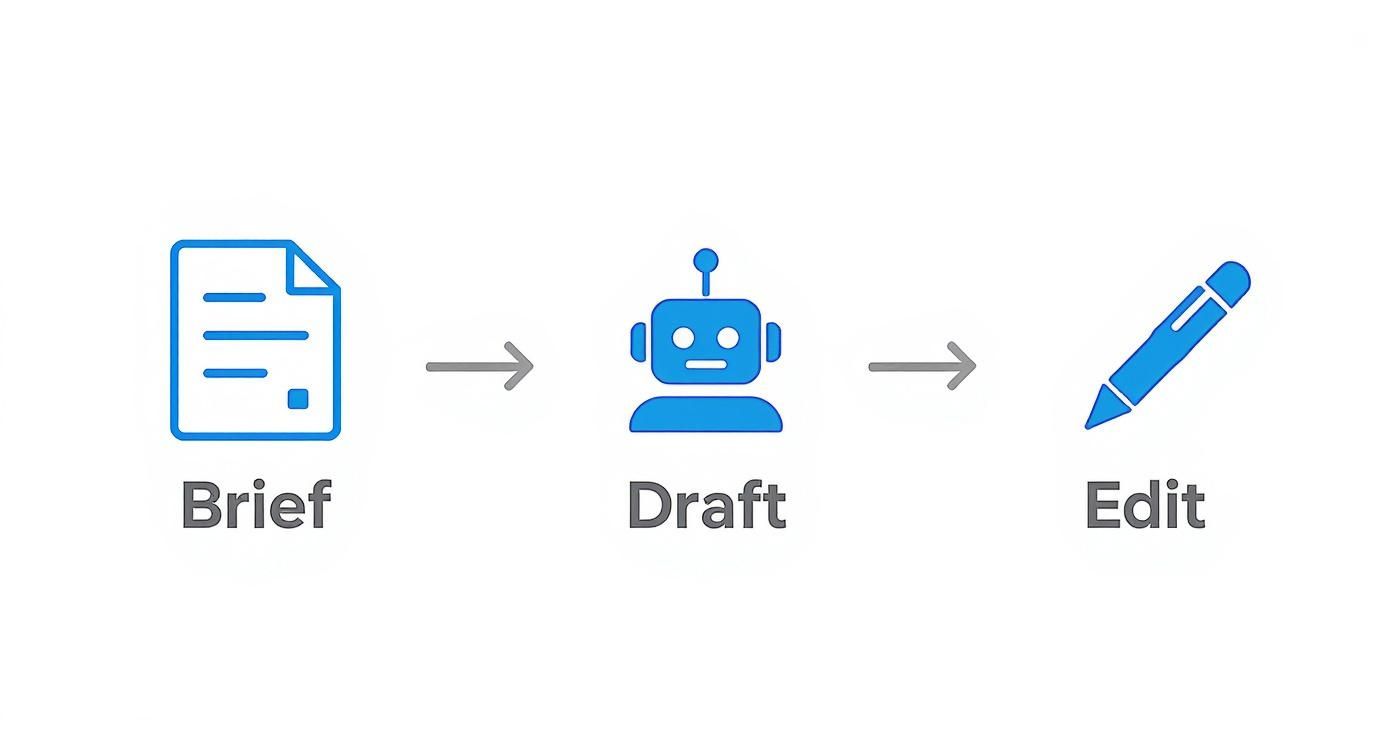
The key is to use AI as a starting point for a draft, not as the final publisher. Your job is to edit, fact-check, and inject your own expertise before anything goes live. Raw, unedited AI output just won't cut it.
What Is the Best Way to Start Using AI?
Jumping in doesn't have to be complicated. The best way to get your feet wet is to start small with specific, low-risk tasks. This helps you figure out how to write good prompts and get a real feel for the tool's strengths and weaknesses before you bet a big project on it.
Here are a few easy ways to get started:
- Brainstorm headlines for your next article.
- Write three different captions for one of your social media photos.
- Summarize a long report into a few key bullet points for an email.
By starting with these simple tasks, you'll build confidence and quickly learn how to make AI a practical and genuinely useful part of your routine.
Ready to scale your outreach and book more meetings with less busywork? Unibox combines LinkedIn and email automation with an AI assistant to help you prospect smarter. Start your free 14-day trial and see how you can focus on conversations that convert.