what are the different types of writing styles: quick guide
Published on 2025-11-29
Ever been asked, "what are the different types of writing styles?" The simplest, most straightforward answer usually points to four big ones: expository, descriptive, persuasive, and narrative writing.
Think of these as the primary colors of the writing world. Just about everything you read—from a quick text to an epic novel—is built from a mix of these foundational styles. They are the essential building blocks of communication.
Your Guide to the Four Core Writing Styles

Getting a handle on these different writing styles isn't about memorizing a bunch of rigid rules. It’s more about knowing you have a toolkit and picking the right tool for the job. Each style is designed to do something different and get a specific reaction from your reader. A builder wouldn’t use a hammer to saw a board, right? Same idea. You wouldn't use storytelling to write a technical manual.
This core group of four—expository, descriptive, persuasive, and narrative—is the standard pretty much everywhere, from classrooms to boardrooms. You actually see expository writing, which is all about explaining things, every single day in textbooks, news articles, and how-to guides. If you want to dig deeper, you can learn more about these writing style classifications and just how common they are.
The Purpose Behind Each Style
To really nail these styles, start by thinking about your goal. What do you want your writing to do? Once you know that, choosing the right style becomes much clearer.
- Expository writing is all about one thing: to inform or explain. It’s the straight-up delivery of facts, no personal opinions allowed.
- Descriptive writing wants to paint a picture with words. The goal here is to pull the reader in with sensory details so they can see, hear, and feel what you’re describing.
- Persuasive writing is on a mission to convince someone of something. It uses a mix of logic, evidence, and emotional appeals to bring the reader over to your side.
- Narrative writing exists to tell a story. It guides the reader through a sequence of events, usually with characters and a plot that create an emotional connection.
Here’s a simple way to remember it: Expository is the "what," descriptive is the "how it looks and feels," persuasive is the "why you should," and narrative is the "what happened next."
To make this even easier, here's a quick cheat sheet that pulls everything together.
The Four Foundational Writing Styles at a Glance
This table breaks down each of the four main styles, showing you their primary goal and where you’re most likely to find them out in the wild.
| Writing Style | Primary Purpose | Commonly Found In |
|---|---|---|
| Expository | To inform and explain | Textbooks, news reports, how-to guides |
| Descriptive | To create sensory detail | Poetry, product descriptions, diary entries |
| Persuasive | To convince and argue | Opinion editorials, advertisements, reviews |
| Narrative | To tell a story | Novels, short stories, memoirs, case studies |
Once you start looking, you'll see these styles everywhere. They often blend together, but understanding their individual purpose is the first step toward becoming a more intentional and effective writer.
Putting the Four Foundational Styles Into Practice

Knowing the four core writing styles—expository, descriptive, persuasive, and narrative—is one thing. But seeing them out in the wild is where the real learning kicks in. Let's get out of the textbook and break down how each style works in the real world with examples you can actually use.
We’ll look at how these styles show up in content you probably read every day: a news brief, a product description, an opinion piece, and a story. Each one has a completely different job to do, and it uses a specific style to get it done.
To make it even more practical, we’ll then translate each style into a "LinkedIn Power Post." This will show you exactly how to use these techniques to build your personal brand, share a win, or make a compelling argument for your point of view.
Expository Writing: The Art of Clarification
At its heart, expository writing is all about clear, straightforward communication. Its only goal is to explain or inform. There’s no room for personal opinion here—it’s the most direct route for getting information from your brain to your reader’s.
Think of it as the style of textbooks, how-to guides, and news reports. It’s all about the facts, presented logically and without any fluff.
Real-World Example: A News Report Snippet
"The Federal Reserve announced Wednesday it would hold interest rates steady, citing signs of a moderating but resilient economy. The decision, which was widely expected by economists, keeps the benchmark federal funds rate in a range of 5.25% to 5.5%. Officials noted that while inflation has eased over the past year, it remains elevated, and the committee remains highly attentive to inflation risks."
See how that’s pure information? It gives you the facts ("hold interest rates steady"), backs them up with data ("5.25% to 5.5%"), and explains the "why" without trying to convince you of anything. It’s there to educate, plain and simple.
LinkedIn Power Post Using Expository Style
This is perfect for when you want to inform your network about a new trend or report in your industry.
- Headline: 3 Key Takeaways from the Latest AI in Sales Report
- Post: The new Gartner report on AI adoption just dropped, and the findings are significant for B2B sales teams. Here’s what you need to know:
- Increased Efficiency: Teams using AI-powered outreach tools saw a 22% increase in meetings booked per rep. The primary driver was automated follow-up sequences.
- Data-Driven Insights: AI isn't just for automation. The report highlights that 68% of high-performing teams use AI to analyze conversation data and identify top-performing messaging.
- Personalization at Scale: The most successful reps leverage AI not to replace personalization, but to enhance it by surfacing key prospect details and suggesting relevant talking points.
- Call to Action: What are your thoughts on these trends? Are you seeing similar results?
Descriptive Writing: The Power of Imagery
Descriptive writing is all about painting a picture with words. It pulls the reader into a scene by appealing to their senses—not just sight, but sound, smell, touch, and even taste. It’s about making the reader feel like they are there.
While it’s the bread and butter of fiction, descriptive writing is a secret weapon in marketing. It helps a customer imagine what it would be like to use a product, turning a list of features into a real, tangible experience.
Real-World Example: A Product Description
"Our signature 'Dawn' candle blends the crisp scent of morning dew on freshly cut grass with a subtle hint of white jasmine. Hand-poured into a frosted glass vessel, its slow-burning soy wax casts a soft, warm glow that fills the room without being overpowering. Light it to transform your hectic morning into a moment of quiet calm."
You can almost smell the grass, can’t you? It uses sensory words like “crisp scent” and “soft, warm glow” to connect the product to an emotional outcome—a feeling of calm.
LinkedIn Power Post Using Descriptive Style
Use this to share a personal experience or capture the vibe of your company culture.
- Headline: That "Aha!" Moment
- Post: You know that feeling when a complex project finally clicks into place? The energy in the room shifts. The frantic scribbling on the whiteboard slows down, replaced by confident, clean lines connecting ideas. There’s a shared sigh of relief, followed by the quiet hum of keyboards as the team, now perfectly aligned, dives into execution.
- Call to Action: That was our Tuesday. It’s moments like these that make all the hard work worth it. #Teamwork #ProjectManagement
Persuasive Writing: The Skill of Conviction
Persuasive writing has a clear agenda: to get the reader to agree with a certain viewpoint or take a specific action. It builds its case using a mix of solid logic, emotional connection, and hard evidence.
This is the style of op-eds, advertisements, and sales pages. The writer isn't just laying out facts; they're strategically guiding you toward a conclusion they want you to reach.
Real-World Example: An Opinion Editorial Excerpt
"While the push for a four-day workweek is gaining traction, companies must look beyond the surface-level benefits. The data clearly shows that without a fundamental redesign of workflows, a compressed schedule often leads to increased employee burnout, not less. We must prioritize smarter work, not just shorter hours, to create a truly sustainable model for the future."
This excerpt takes a firm stance ("look beyond the surface-level benefits") and supports it with a logical argument ("leads to increased employee burnout"). The language is strong and direct, designed to sway your opinion.
LinkedIn Power Post Using Persuasive Style
This is your go-to when you want to challenge an industry norm or advocate for a new strategy.
- Headline: Stop Chasing Cold Leads. Start Building an Audience.
- Post: The traditional outbound model is broken. Sending 100s of generic emails a day for a 1% reply rate isn't a strategy; it's a slot machine. A better approach? Invest that time in sharing valuable insights right here. When you consistently educate your network, the right prospects don't need to be chased—they come to you.
- Call to Action: It’s time to shift from interruption to attraction. Agree or disagree?
Narrative Writing: The Magic of Storytelling
Finally, there’s narrative writing. Put simply, it tells a story. Every good story has characters, a setting, and a plot that moves things along. Its goal is to hook the reader on an emotional level, making the message stick.
From novels and memoirs to brand origin stories and customer case studies, storytelling connects with us in a way that data just can't. A powerful narrative can make a complex idea feel simple, personal, and unforgettable.
Real-World Example: A Story Opening
"It was three weeks before our biggest product launch, and our lead engineer walked into my office. He didn't say a word—he just placed a single, burnt circuit board on my desk. In that moment, I knew our entire timeline was about to go up in smoke."
That first paragraph creates instant tension, right? It introduces a character, a problem, and high stakes. You're immediately pulled in and want to find out what happens next. That’s the power of a good narrative hook.
LinkedIn Power Post Using Narrative Style
Perfect for sharing a hard-won career lesson or a powerful customer success story.
- Headline: My Biggest Sales Mistake
- Post: Early in my career, I lost a huge deal. I had done everything "right"—demo, follow-up, proposal. But I spent the whole time talking about our product's features, not my prospect's problem. On our final call, they said, "This is a great tool, but it doesn't solve our core issue." That failure taught me a crucial lesson: Stop selling a product and start solving a problem.
- Call to Action: It was a painful lesson but a necessary one. What's a failure that ultimately made you better at your job? #Sales #CareerGrowth
Getting Specific: Writing Styles in the Professional World
While the four main styles are the foundation, the professional world has its own set of specialized tools. Think of it like a mechanic's toolbox. You have your basic screwdrivers and wrenches (the four core styles), but for specific jobs, you need a torque wrench or a spark plug socket.
These professional styles aren't new inventions; they're specific blends of the core four, fine-tuned for particular industries and goals.
Understanding these different types of writing styles is about knowing the job you need to do. Technical writing is all about crystal-clear instruction. Journalistic writing is built for speed and objectivity. Academic writing constructs arguments on a foundation of solid evidence. And business writing? It’s all about getting things done.
Let's break down how each one works.
Technical Writing: The Pursuit of Precision
Technical writing is the craft of making the complex feel simple. The entire goal is to educate and instruct, leaving absolutely no room for confusion or misinterpretation. If you’ve ever put together IKEA furniture, followed a software tutorial, or read a scientific report, you've seen technical writing in action.
At its heart, this is a super-focused version of expository writing, but with an intense emphasis on accuracy and step-by-step procedure. A great technical writer anticipates your questions and answers them before you even think to ask. They have to be both a subject matter expert and a champion for the beginner, translating dense jargon into clear, actionable guidance.
Think of it as a GPS for a complicated process. It doesn’t give you scenic detours or fun facts; it provides precise, turn-by-turn directions to get you from A to B without a single wrong turn.
Real-World Example: A User Manual Snippet
Step 3: Connect to Wi-Fi Network
- Navigate to the Settings menu using the main control dial.
- Select Network & Internet from the list.
- Toggle the Wi-Fi switch to the On position. The device will scan for available networks.
- Choose your network from the list and enter the password when prompted. A checkmark will appear next to the network name upon successful connection.
Journalistic Writing: The Inverted Pyramid
Journalistic writing is built for speed and impact. Its purpose is to inform people about newsworthy events as quickly and objectively as possible. You’ll find it in newspapers, online news sites, and TV news reports, where getting the most important information to the reader first is the top priority.
The signature of this style is the inverted pyramid structure. A story usually builds to a climax, but a news article does the exact opposite. It front-loads all the critical information—the who, what, when, where, and why—in the very first paragraph. From there, the details become progressively less essential. This genius structure means someone who only skims the headline and the first sentence still walks away knowing the core of the story.
Real-World Example: A News Lead
"City officials approved a $15 million infrastructure plan Tuesday morning aimed at upgrading the downtown water system over the next five years. The project, set to begin in October, will replace aging pipes to improve water quality and prevent future service disruptions for over 50,000 residents."
Academic Writing: The Evidence-Based Argument
Academic writing is the formal, evidence-based style you’ll find in scholarly journals, research papers, and dissertations. The goal here is to share original research, add to an ongoing conversation among experts, and build a logical argument that can be defended with credible sources.
This style is structured, analytical, and incredibly disciplined. The writer must present a clear thesis and then back it up with data, citations from other experts, and sound reasoning. It’s written for a very specific audience: other experts in the same field.
Research into higher education pedagogy reveals four major categories of academic writing: descriptive, analytical, critical, and persuasive. Globally, around 70% of university-level writing assignments require students to blend these approaches, reflecting the complex thinking needed to produce scholarly work.
This isn't about flashy prose or creative flair. It's about contributing a verifiable piece to the massive, ongoing puzzle of human knowledge.
Business Writing: The Drive for Action
Finally, we have business writing. This is probably the most action-oriented style of them all, covering everything from emails and memos to formal reports and project proposals. The goal is almost always to get someone to do something: approve a budget, respond to a question, or schedule a meeting.
The hallmarks of great business writing are clarity, brevity, and professionalism. It cuts the fluff and gets straight to the point because the audience—whether it's your boss, your client, or your team—is always short on time. A perfect business email states its purpose in the first sentence and clearly lists the next steps.
This style is a practical mix of expository and persuasive writing, designed for results. Anyone looking to communicate more effectively at work needs to get this right. To learn more, check out our guide on essential business writing tips for professionals.
Real-World Example: A Professional Email
Subject: Project Alpha Q3 Budget Proposal for Review
Hi Team,
Attached is the budget proposal for Project Alpha for Q3. Please review the document by EOD Thursday, April 18th, and leave your feedback in the shared file.
The key highlight is a 5% increase in the content budget to support our new video initiative.
We will discuss and finalize the budget during our weekly sync on Friday.
Thanks, Jane
Unlocking the Power of Creative Writing Styles
Step outside the formal structures of business reports and academic papers, and you’ll find a world where imagination reigns supreme. This is the realm of creative writing, where the goal isn't just to inform, but to move, inspire, and create a genuine experience for the reader.
Creative writing is all about artistic expression. It aims to entertain, to make you think, and to forge a connection on a deeply human level. This is where writers build worlds from scratch, introduce us to unforgettable characters, and play with language like it’s a musical instrument.
The Major Forms of Creative Expression
The craft of creative writing shows up in many different forms, each with its own set of tools and goals. Getting to know them helps you see the artistry behind your favorite books, poems, and movies.
Three of the most common creative styles are:
Fictional Writing: At its heart, this is storytelling with imagined characters and events. Whether it's a massive fantasy novel or a quiet short story, fiction uses plot, character arcs, and vivid settings to pull the reader into another world.
Poetic Writing: Poetry is all about the beauty and power of language itself. It uses rhythm, sound, metaphor, and imagery to pack big emotions and complex ideas into a small space. It's writing designed to be felt just as much as it's understood.
Scriptwriting: This is the essential blueprint for everything we watch, from films and TV shows to stage plays. It’s a unique style that balances dialogue with scene descriptions and action notes to build a story that’s meant to be performed and seen.
Putting Creative Writing to Work
Don't mistake creative writing for a purely artistic pursuit—it has tremendous practical value. It teaches you how to forge an emotional connection with an audience, a skill that is absolutely golden in marketing, leadership, and building a personal brand.
A great story can make a complex idea feel personal and unforgettable. In a world saturated with data, a creative narrative is what helps your message stand out and stick. It’s the difference between a forgettable presentation and a story that inspires action.
Even a dash of creative flair can make your everyday professional communication far more engaging and memorable.
When you feel like your ideas are stuck in a rut, diving into creative exercises can be the perfect way to get unstuck. If you're wrestling with that dreaded blank page, you can learn more about how to overcome creative block and find your voice again. This isn't just for novelists or poets; it can bring a fresh, human-centered perspective to your professional work, too.
How to Choose the Right Writing Style Every Time
https://www.youtube.com/embed/maL3IimaY3Y
Knowing the different writing styles is one thing. But the real skill? It's picking the perfect one for the job at hand. This is where you turn knowledge into a strategic advantage, ensuring your message doesn't just get seen—it gets felt.
You don’t need some complex formula to get it right. All it takes is asking yourself three straightforward questions before you even type a word. Think of these as your compass, pointing you toward the most effective style every single time.
The Three Core Questions for Style Selection
Great writing always starts with a solid foundation. Answering these questions gives you a clear blueprint, making your choice of writing style feel almost second nature.
- What Is My Purpose? Start here. Always. What are you trying to accomplish? Are you here to inform, convince, entertain, or instruct? Your "why" is the most critical piece of the puzzle.
- Who Is My Audience? Next, picture who you're talking to. What do they already know? What are their expectations? You wouldn't write for a team of software engineers the same way you’d write for potential new customers, right?
- What Is My Platform? Finally, where is this piece going to live? The unwritten rules of a formal business proposal are worlds away from the vibe of a LinkedIn post or a casual company blog. The platform shapes everything from format and tone to length.
Once you answer these, the path becomes clear. For example, if you're writing a project proposal (Platform) for a new client (Audience) to win a contract (Purpose), you naturally lean into a mix of persuasive and business writing. You need to sell them on your value, but within a professional and structured format.
Matching Your Goal to the Right Writing Style
To make it even easier, here's a quick cheat sheet for matching your goal with the right style. Think of this table as a quick reference to get you started.
| Your Goal | Primary Writing Style to Use | Example Scenario |
|---|---|---|
| To explain a complex topic clearly | Expository | Writing a knowledge base article for new software users. |
| To convince a stakeholder to approve a budget | Persuasive & Business | Crafting a formal proposal with data-backed arguments. |
| To share a personal career lesson | Narrative | Posting an engaging story on LinkedIn to build your brand. |
| To make a product feel irresistible | Descriptive | Writing website copy that highlights sensory details. |
This shows that picking a style isn't just about how you write—it's a deliberate choice that directly influences your outcome. It’s about picking the right tool for the job.
If you’re ever in doubt, remember that these styles are so distinct that even computer systems can tell them apart. Researchers use computational linguistics to classify texts by looking at everything from word choice to sentence structure. You can dive deep into the full research on these linguistic analysis methods to see just how measurable these differences are.
Ultimately, the style you choose becomes a core part of your tone, delivery, and unique voice. If you're ready to take that next step, our guide on how to find your writing voice will help you make your communication even more memorable.
This simple decision tree is a great way to visualize how your goal—entertain, inspire, or visualize—can direct your choices, even within a single category like creative writing.
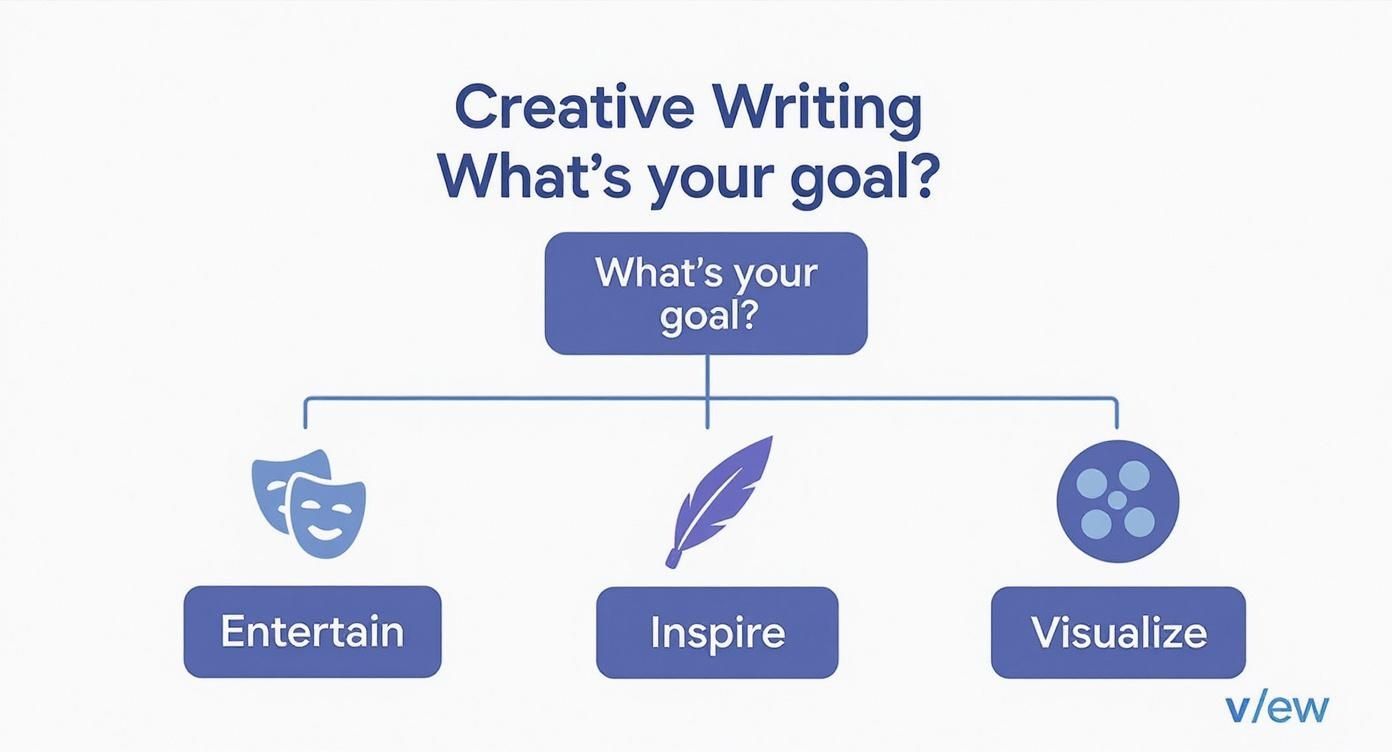
As you can see, even in a broad field like creative writing, your specific objective is what lights the way forward.
Blending Writing Styles for Greater Impact
The best writing rarely stays in one lane. The most effective communicators know that these different writing styles aren't rigid rules to be followed—they're tools in a toolbox. By mixing and matching them, you can create something far more interesting, dynamic, and persuasive.
Think of it like a master chef. They don't just throw salt on a dish; they balance savory, sweet, and acidic notes to build layers of flavor. As a writer, you can do the same thing by weaving different styles together to take your reader on a journey.
This approach lets you accomplish several things at once. A really great blog post, for instance, is often a perfect blend. It might pull you in with a compelling story (narrative), teach you something new with straightforward facts (expository), and then nudge you toward a specific action (persuasive).
The Anatomy of a Hybrid Piece
So, what does this look like in the real world? Let’s break down a common example: a case study designed to attract new clients. A truly powerful case study doesn’t just list facts; it skillfully combines multiple styles.
Narrative Hook: It starts with a story. We meet the client, a relatable character struggling with a challenge we understand. This builds an instant emotional connection.
Expository Explanation: Then, it switches gears to clear, expository writing. This is where the step-by-step process and the technical details of the solution are laid out plainly.
Descriptive Details: To make the success tangible, the writer uses descriptive language to paint a vivid picture of the "after." You can almost feel the client's relief or see the improved metrics on a dashboard.
Persuasive Close: It wraps up with a strong persuasive call-to-action. The success story becomes the proof, the compelling evidence that encourages the reader to book their own demo or get in touch.
By layering these approaches, the writer does more than just present information. They build a powerful argument that connects on both an emotional and a logical level, turning a simple report into a genuine sales asset.
This strategic combination is how you elevate your writing from merely informative to truly memorable. When you learn to blend these elements, you don't just answer the question of "what are the different types of writing styles"—you show their combined power in action.
Common Questions About Writing Styles
Getting a handle on the different writing styles is one thing, but putting them into practice is where the real questions pop up. Let's tackle some of the most common ones so you can start applying these ideas with confidence.
Can a Single Document Use More Than One Writing Style?
Not only can it, but it absolutely should. The best writing often weaves multiple styles together.
Think about a killer marketing email. It might kick off with descriptive language to make a product feel real, drop in a short narrative (a customer story) to build trust, and then switch to a persuasive style for a can't-resist call-to-action. The trick is making the blend seamless, so each style serves a clear purpose without feeling jarring to the reader.
What Is the Most Common Type of Writing Style?
That’s an easy one: expository writing. It's the engine of everyday communication. You’ll find it in textbooks, news articles, how-to guides, and the internal reports you read at work.
Its job is simple: to inform and explain. It’s all about delivering the facts clearly and without a personal slant. It’s the foundation that most other communication is built on.
Key Takeaway: While other styles bring the personality and emotion, expository writing does the heavy lifting, making sure the core message gets across loud and clear.
How Do I Identify My Own Natural Writing Style?
The best way to figure out your go-to style is to look at your "off-the-clock" writing—things like personal emails, journal entries, or even your social media posts. Read through a few and see what patterns jump out.
Do you find yourself telling little stories to get your point across? That’s a narrative leaning. Are you always breaking things down and explaining how they work? You're probably an expository writer at heart. Or are you constantly trying to get people to see things your way? Hello, persuasive writer. Knowing your default is the first step to choosing the right style for the job, instead of just falling back on what’s comfortable.
Ready to turn those insights into outreach that books meetings? Unibox helps you apply the right style to every email and LinkedIn message, with AI assistance and powerful automation. Start your free 14-day trial today.