
Mastering Strategic Communication Planning
Published on 2025-11-26
Strategic communication planning is just a fancy way of saying you have a roadmap for everything you say and write. It’s about making sure every email, social media post, and internal memo has a clear purpose and works toward a specific business goal.
Why Strategic Communication Planning Matters Now
Let's be honest, the world is noisy. In this environment, a solid communication plan isn't some dusty corporate document you create once and forget. It's your leadership playbook. It's how you cut through the chaos, build trust when it feels impossible, and get your entire team rowing in the same direction.

This isn't just theory; it's a direct response to the world we live in. Over the past few years, we’ve all seen that communication is now a core leadership skill, not just a department down the hall.
The Shift from Support Role to Leadership Imperative
For a long time, communications was seen as a tactical function—the people you called to write a press release or post on social media. That thinking is officially obsolete. By 2025, strategic communication has become a central part of leadership, thanks to massive disruptions like global health crises, social movements, and the explosion of AI.
This new reality means communication is how you build trust and keep everyone aligned when things get turbulent. You can find more about this shift in the industry over at wearecsg.com.
Effective communication has become the engine for core business strategy. It’s the primary tool for:
- Building Trust: People are skeptical. Consistent, transparent communication is the only way to build real credibility with your employees, customers, and investors.
- Driving Alignment: When everyone in the organization clearly understands the mission and their part in it, you can move faster and more effectively. Simple as that.
- Managing Change: Launching a product? Reorganizing a team? A clear communication plan is what separates a smooth transition from a confusing mess.
A well-crafted plan helps you lead through uncertainty. It transforms communication from a reactive, scattered effort into a proactive, measurable driver of your business.
Adapting to a New Communication Reality
The need for a formal strategic communication planning process is more urgent than ever. The old gatekeepers of information are gone; now, every employee and customer has a microphone. At the same time, people expect organizations to communicate with more authenticity and purpose than ever before.
This guide will give you a practical framework for building a communication plan that actually works today. We’ll walk through defining your goals, understanding your audience, crafting messages that stick, and turning that strategy into something your team can execute every single day.
Setting Goals and Defining Your Audience
A plan without clear goals isn't a plan at all—it's just a wish list. Before you even think about writing a single post or email, your strategic communication planning has to start with one simple question: What are we actually trying to accomplish here?
Vague goals like "increase brand awareness" are the enemy of effective communication. You need specific, measurable objectives that tie directly back to what the business needs to achieve.

Let's make this real. Say your company's big-picture goal is to reduce customer churn by 15% this year. A weak communication objective would be "improve customer communication." A strong one? "Increase customer engagement with new feature tutorials by 25% to drive product adoption." See the difference? One is fluff; the other links your work directly to a tangible business outcome.
Mapping Business Goals to Communication Objectives
This is probably the most critical part of the entire process—connecting the high-level business targets to what your communication will actually do. When you get this right, your plan stops being a list of tasks and becomes a powerful tool for driving real results.
Here’s a practical look at how to translate those big business goals into concrete communication objectives.
Mapping Business Goals to Communication Objectives
| Business Objective | Primary Audience | Communication Objective | Key Performance Indicator (KPI) |
|---|---|---|---|
| Increase Q3 sales by 20% | Prospective customers | Drive 1,000 demo requests from the new product landing page | Demo form conversion rate |
| Improve employee retention by 10% | Current employees | Increase awareness of new professional development programs | Program enrollment numbers |
| Secure Series A funding | Potential investors | Position the CEO as a thought leader in the FinTech space | Mentions in top-tier financial media |
This translation exercise does more than just fill out a chart. It forces you to be crystal clear about your purpose, which makes it infinitely easier to prove the value of your work down the line.
Going Beyond Demographics to Understand Your Audience
Okay, you know what you want to achieve. Now you have to get laser-focused on who you're talking to. And I don’t just mean "males aged 25-40." That's a demographic, not an audience. True strategic communication requires a much deeper dive into the people you need to reach.
An audience is a group of people with shared motivations, concerns, and communication habits. Your job is to uncover what makes them tick so your message actually connects.
This is where creating detailed audience personas is a game-changer. These aren't just fluffy descriptions; they are empathy-building tools based on real research. Personas are fictional characters that represent the different types of people who will engage with your company. For a great primer on this, check out this guide on what is audience analysis.
Let's imagine you’re a B2B tech company launching a new AI-powered analytics tool. Your audience isn't a monolith called "companies." It’s actually a handful of very different people:
- "Data-Driven Dan" (The Analyst): He lives and breathes technical specs, data accuracy, and API integrations. He’s allergic to marketing fluff and trusts technical blogs and niche forums for his information.
- "Strategic Sarah" (The VP of Marketing): She’s focused on the bottom line: ROI, competitive advantage, and how this feature helps her team crush its lead generation goals. You'll find her reading major industry publications and following key influencers on LinkedIn.
- "Cautious Chris" (The IT Director): His world revolves around security, compliance, and the implementation burden on his already-swamped team. He’s only won over by detailed documentation and case studies from companies just like his.
Each of these people needs a completely different message, delivered through a different channel. Dan wants a technical whitepaper. Sarah needs a quick case study highlighting clear ROI. And Chris won't move an inch without a detailed security brief. If you don't segment your audience this deeply, you're essentially just shouting into the void and hoping someone hears you.
Crafting Your Message and Channel Strategy
Now that you know your goals and who you're talking to, it's time to figure out the "what" and the "where." This is the fun part: developing the core story you want to tell and then picking the best places to tell it.
This isn't about shouting the same thing from every rooftop. It’s about crafting a central, unified message that’s flexible enough to be tweaked for different audiences and channels without losing its soul. A solid core narrative means that whether someone finds you on LinkedIn, reads your blog, or gets an email, they get a consistent sense of who you are and what you stand for.
Developing Your Core Narrative
Think of your core narrative as the DNA of your organization. It's the big-picture story that weaves together your mission, your values, and what makes you uniquely valuable into a single, compelling idea. It’s the source code for everything you say and do.
Authenticity is everything here. This isn't just a slick marketing slogan; it's a genuine reflection of why you exist. To get to the heart of it, try asking these questions:
- What specific problem do we solve better than anyone else?
- What core belief is the engine behind our work?
- If our brand was a person, what would they be like?
The answers will help you build a story that sticks. For a deeper dive, our guide on creating an authentic brand voice guide can walk you through refining this. Ultimately, your narrative needs to be simple enough for every single person in your company to understand and repeat.
A clear, unified message is a direct line to growth. When your story is consistent everywhere, it builds trust and cuts through the noise, making it way easier for people to grasp your value.
This isn't just a nice idea. The 2025 Clarity Index research, a global study of 100 major U.S. corporations, found a direct link between clear corporate messaging and better business performance. Their big takeaway? Success comes from the core communication strategy itself, not just a bunch of one-off tactics.
Choosing the Right Channels
With your core message locked in, the next question is where it should live. A classic mistake is the "spray and pray" method—trying to be everywhere at once. A much smarter approach is to intentionally pick the right mix of owned, earned, and paid media.
- Owned Media: This is your turf. Think of your company blog, website, email newsletters, and social media profiles. You have complete control here, making it the perfect place to build a community.
- Earned Media: This is the buzz you get from others—media mentions, guest articles, glowing customer reviews. It's incredibly powerful because it comes with built-in credibility from a third party.
- Paid Media: This is where you pay to play. We're talking social media ads, search engine marketing, and sponsored content. It's fantastic for getting in front of new audiences, fast.
The magic happens when you integrate all three. For example, you could publish a deep-dive case study on your blog (owned), run LinkedIn ads to promote it (paid), and get an industry publication to cover your findings (earned).
A Practical Example with LinkedIn
Let's see how this works for a B2B company trying to position its CEO as a thought leader. Instead of just posting random company news on LinkedIn, a truly strategic plan looks more like this:
- Core Narrative: "We believe small businesses deserve the same powerful analytics as large enterprises."
- Owned Channel (LinkedIn): The CEO regularly shares insightful analysis of industry trends, not just product pitches. They tell personal stories and actively engage with people in the comments.
- Paid Channel (LinkedIn Ads): You boost the CEO's best-performing posts to a highly targeted audience of potential customers who aren't yet following them, dramatically expanding their influence.
- Earned Channel (Industry Media): You successfully pitch the CEO’s unique perspective to a popular industry podcast. After the interview airs, you slice up clips and share them back on LinkedIn, creating a powerful feedback loop.
This integrated approach means every action has a clear purpose. Each channel supports the others, amplifying your core story and building real momentum toward your goals.
Bringing Your Communication Plan to Life
An amazing strategy is useless if it just collects dust in a slide deck. The real magic happens when you turn those brilliant ideas into consistent, daily action. This is where your plan stops being a document and becomes a living, breathing part of how you operate.
A good plan provides a practical roadmap for getting things done. It takes you from abstract goals to a manageable communication rhythm for your team—one that doesn't lead to total burnout after the first month.
This is how I like to visualize the flow: from your core story all the way down to the channels where you'll share it.
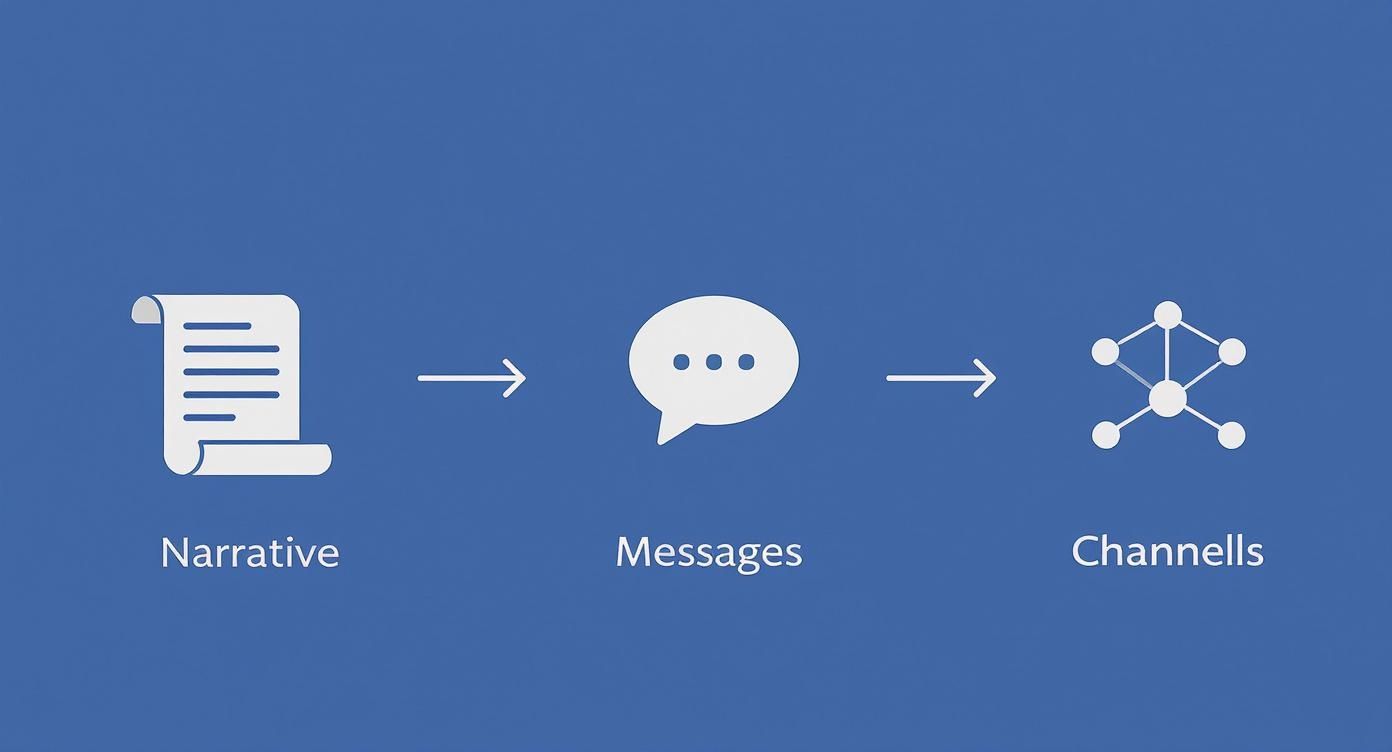
It’s a simple reminder that your big-picture narrative should be the source for every single message you craft and every platform you choose.
Establishing a Content Cadence
Instead of a chaotic, last-minute scramble for something to post, a solid plan creates a predictable cadence. This usually means mapping out your content themes weeks or even months ahead of time. Think of them as mini-campaigns that keep your messaging focused and tight.
Let's say you're a B2B software company. You might dedicate an entire month to the theme of "improving team productivity." Your calendar could then break down like this:
- Week 1: A deep-dive blog post exploring common productivity bottlenecks.
- Week 2: A short LinkedIn video from the CEO sharing their personal top productivity hacks.
- Week 3: A customer success story showing how a client saved 20 hours a week using your tool.
- Week 4: A live Q&A on LinkedIn with a product expert to discuss advanced features.
This thematic approach not only makes planning way easier but also ensures your audience gets a consistent, valuable message over time. You stop committing random acts of content and start building a strategic program with real momentum.
The goal isn't just to create more content; it's to create more effective content with less friction. A clear plan with assigned roles puts an end to the last-minute panic and keeps the quality high.
Creating an Efficient Workflow
A strong workflow is the engine that actually powers your plan. It needs to outline every single step, from the initial idea to hitting "publish," and make it crystal clear who is responsible for what. Without this, even the best ideas get lost in endless email chains and blown deadlines.
Your workflow should spell out a few key things:
- Content Creation: Who’s writing the copy? Who’s designing the graphics or shooting the video?
- Review and Approval: Who gets the final say before something goes live? A pro tip: keep this approval circle as small as possible to avoid bottlenecks.
- Distribution and Scheduling: Who is physically posting the content to each channel and making sure it goes out at the right time?
Today’s tools can make this much smoother by automating scheduling and keeping all the feedback in one place. By setting up a clear and efficient workflow from the start, you free up your team to do what they do best—focus on the creative and strategic work, not the administrative headaches.
Measuring What Matters and Adapting Your Plan
A communication plan that just sits in a folder is worthless. Think of it as a living document, a guide that needs constant attention to tell you if what you’re doing is actually working. This final piece of the puzzle—measurement and adaptation—is where you turn raw data into your most valuable asset.
This means looking past the easy vanity metrics like likes and shares. We need to get back to the core key performance indicators (KPIs) we set at the very beginning. Are you actually getting more demo requests? Did enrollment for that new employee benefits program go up? Those are the numbers that prove your communication efforts are hitting the mark and impacting the business.
From Reporting to Responding
The real magic of measurement isn’t just about looking backward and creating pretty reports. It’s about using that data to make smarter decisions for what comes next. When you pair hard numbers, like website traffic, with qualitative feedback, like social media sentiment, you get a full 360-degree view of what’s connecting with your audience and what’s just making noise.
This isn't just a "nice-to-have" skill anymore. A global study of over 450 internal comms pros found that by 2025, using analytics to fine-tune strategy is a top priority. The message is clear: if you want to succeed, you have to measure and adapt. You can dig into the full report on strategic planning at akademische-gesellschaft.com.
If you need a practical starting point for what to track, our guide on how to measure content performance breaks it down and helps you connect your content to real results.
An agile communication plan is one that evolves with your audience and the market. Your data tells you when it's time to pivot, double down, or try a completely new approach.
Building a Strategic Review Cycle
To make this kind of adaptation part of your DNA, you need a system. I've found that setting up a regular strategic review cycle—whether it's monthly or quarterly—is non-negotiable for building an agile comms function. This is dedicated time for the team to step back and ask the tough questions.
Here’s a simple agenda for that meeting:
- Review KPIs: Are we hitting our targets? If not, what’s holding us back?
- Analyze Wins: What went really well this past month? How can we bottle that lightning and do it again?
- Assess Failures: Which campaigns or messages fell flat? What’s the lesson here?
- Adapt the Plan: Based on everything we just discussed, what needs to change for the next cycle?
This kind of disciplined process transforms your strategic communication planning from a once-a-year chore into a dynamic, ongoing conversation. It’s what keeps your efforts sharp, relevant, and always pointed toward your biggest goals.
Answering Your Toughest Strategic Communication Questions
Even the best-laid plans hit a few bumps in the road. You might face skeptical stakeholders, an unexpected market shift, or a budget that’s tighter than you’d like. Knowing how to handle these common challenges is what makes a communication plan truly effective.
Let's dive into some of the questions that come up time and time again during the planning process. The goal here is to give you quick, practical answers to keep you moving forward.
How Do I Get Leadership to Actually Back This Plan?
Getting the green light from the top can feel like the biggest hurdle. Leaders are laser-focused on the bottom line, so you have to speak their language. Forget talking about "engagement" or "brand voice" for a moment and connect your plan directly to the numbers they care about.
You have to show them exactly how your communication efforts will drive real business results.
- Talking to Sales? Frame it like this: "This thought leadership campaign is designed to generate 20% more marketing-qualified leads for your team next quarter."
- Pitching HR? Try this: "Our new internal communication plan will help improve employee retention by 10% by making our professional development programs more visible and accessible."
- Working with Product? Say this: "By sharpening our product messaging, we can cut down on customer support tickets related to feature confusion by 15%."
When you tie your communication plan to ROI, lead generation, or retention, you're not just asking for resources—you're presenting a solid business case.
What If I Don't Have a Big Budget?
A small budget isn't a dead end. It just means you have to be smarter and more creative with your resources. This is where you double down on the channels you already own and control. Think of your company blog, your email list, and the personal LinkedIn profiles of your key team members. These cost very little to use but can have a massive impact.
A tight budget forces ruthless prioritization. It's far better to do one or two things exceptionally well than to spread yourself thin across ten different channels with mediocre results.
Lean into organic growth by creating content that’s genuinely useful and shareworthy. One deeply insightful LinkedIn article from your CEO or a comprehensive guide on your blog can deliver more long-term value than a pricey, short-lived ad campaign. When money is tight, consistency becomes your most powerful tool.
How Do I Adapt When the World (or My Market) Changes?
Let’s be honest: no plan survives first contact with reality. A competitor might drop a surprise product, a social media algorithm could change overnight, or a major news event could completely reset the conversation. Your plan has to be a living document, not a stone tablet.
The trick is to build in a regular review cycle. Whether it's monthly or quarterly, block out time to look at the data and see what’s working and what’s not. This isn’t admitting failure; it's just smart strategy. Use these check-ins to re-evaluate your channels, tweak your messaging, and maybe even adjust your goals based on what you've learned. A plan that can bend without breaking is a plan that will win.
Ready to turn your strategy into action? Unibox helps you manage your LinkedIn and email outreach from a single inbox, automating the busywork so you can focus on building relationships that matter. Start your free trial at https://tryunibox.com.