
Your Practical Social Media ROI Calculator Guide
Published on 2025-12-07
A social media ROI calculator is essentially a tool to figure out if your social media efforts are actually making money. It strips away the fluff and compares what you earned from your social media activities to what you spent. The whole point is to move past surface-level numbers like likes and followers and get to the heart of what really matters: tangible business results.
Why Your Social Media ROI Is Probably Wrong

Let's be honest. For most of us, trying to calculate social media return can feel like throwing darts in the dark. You're creating content, engaging with your audience, and seeing the likes pile up, but drawing a straight line from that activity to your bank account is a massive challenge. It's a common struggle for creators and social media managers, and it’s the reason most ROI calculations are flawed from the get-go.
Too many social media strategies are judged by vanity metrics—things like likes, shares, and follower counts. They look fantastic on a report, but they don't pay the bills. Real business impact comes from actions that actually drive revenue, like generating solid leads, getting people to buy something on your website, or creating fiercely loyal customers.
The Real Cost of Inaccurate ROI
When you're running on superficial data, you end up making bad strategic calls. If you can't prove the real value of what you do, you're setting yourself up for some serious problems:
- Budget Cuts: It's tough to justify your marketing spend to your boss or clients when you don't have hard numbers to back it up.
- Wasted Effort: You could be pouring time and money into a platform that gets tons of engagement but zero qualified leads, all while a more promising channel sits neglected.
- Stagnant Growth: You can't fix what you can't measure. An incorrect ROI means you're flying blind, unable to fine-tune your strategy for better results.
The problem is that often, the "growth" we're tracking is just vanity. It feels good, but it's not a true indicator of business health. For a closer look at what real growth metrics look like, this guide on understanding customer retention rate is a great place to start.
The core issue is confusing activity with achievement. A viral post is an accomplishment, but if it doesn't contribute to a business goal, its ROI is effectively zero. A social media ROI calculator forces you to look beyond the noise.
The classic ROI formula is pretty simple: (Profit ÷ Investment) × 100. So, if you spend $1,000 on a campaign and it brings in $5,000 in profit, your ROI is a whopping 400%.
But here's where it gets tricky. The "investment" piece has to include everything. We're talking ad spend, software subscriptions, the cost of creating content, and yes, even the value of your time. By shifting your focus from vanity metrics to real business outcomes, you can finally turn your social media presence into a defensible, revenue-driving machine.
Tracking the True Cost of Your Social Media
Any ROI calculator is only as good as the numbers you put into it. The old saying “garbage in, garbage out” couldn’t be more accurate here. To get a real sense of your return, you have to be brutally honest about every single penny and minute you’re investing.
Most people just look at their ad spend, but that’s barely scratching the surface. It gives you a completely skewed picture of your actual investment. Getting this part right—digging into all the hidden costs—is what turns a vague guess into a solid metric you can actually stand behind.
Beyond Ad Spend: Finding the Hidden Costs
Your real social media costs are spread across a few key areas. If you miss any of them, your ROI will look artificially high, giving you a false sense of what's working. Let's break down everything you need to be tracking.
Your Time (or Your Team's Time): This is the single biggest cost that gets overlooked, especially for creators and small businesses. Every hour spent brainstorming, creating content, scheduling posts, and engaging with your audience has a real value. You have to assign a number to it.
Software and Tools: Take a look at your entire tech stack. We're talking about scheduling tools like Buffer, analytics platforms, design software like Canva, video editors, and any other subscription that helps you get the job done.
Content Creation Expenses: Did you hire a freelance videographer for that last campaign? Buy a pack of stock photos? Pay for props or new equipment? These are direct costs that can add up fast and they absolutely belong in your calculation.
How to Put a Price on Your Time and Effort
Figuring out a dollar value for your own time can feel a bit strange, but it's non-negotiable for an accurate ROI. A simple way to do it is to ask: if I had to hire someone else to do this work, what would their market rate be? That’s a solid starting point for your own hourly rate.
Let's imagine you decide your time is worth $50 per hour. If you're spending 10 hours a week on social media, that’s a $500 weekly cost. That comes out to roughly $2,000 per month—and that's before you've spent a single dollar on ads or tools. All of a sudden, the investment looks a lot more substantial, doesn't it?
Tracking your time isn't about micromanaging yourself. It's about getting a clear-eyed view of where your resources are really going. This insight alone can show you where you're being inefficient and help you refocus on what truly matters.
To help you get a complete picture of your investment, I've put together a checklist of all the costs you should be tracking. Don't let anything slip through the cracks.
Comprehensive Social Media Cost Breakdown
| Cost Category | Examples | Tracking Method |
|---|---|---|
| Labor Costs | Your hourly rate, employee salaries, freelancer fees | Time tracking software (like Toggl) or a simple weekly log |
| Software Costs | Hootsuite, Canva Pro, Adobe Creative Cloud | Monthly subscription receipts or bank statements |
| Ad Spend | LinkedIn Ads, Meta Ads, TikTok Boosted Posts | Platform-specific ad manager dashboards |
| Content Costs | Stock images, video production, equipment, props | Invoices and receipts for each specific purchase |
By methodically logging every expense, you’re building the reliable foundation you need. This detailed cost analysis ensures the "Investment" side of your ROI equation is rock-solid, which in turn makes your final calculation a powerful tool for your business.
Connecting Social Activity to Business Results
Drawing a straight line from a LinkedIn post to a new client is where most marketers get stuck. It can feel abstract, but this is the most critical part of filling out your social media ROI calculator. You absolutely need a reliable way to translate likes, comments, and clicks into real business value.
The whole process starts with attribution—the art of connecting an action on social media to a result on your website. This is often done using UTM parameters, which are just simple tags you add to your links. When someone clicks a UTM-tagged link in your post, your analytics can tell you exactly where they came from, turning anonymous traffic into a measurable outcome.
From Clicks to Conversions
Here's the thing: not every click leads to an immediate sale, especially in B2B. The real magic happens when you assign a monetary value to actions that aren't direct revenue. These "micro-conversions" are crucial steps in the customer journey and hold a ton of value.
Think about the valuable things a user can do after clicking your social media link:
- Signing up for your email newsletter: Every subscriber has a potential lifetime value.
- Downloading an ebook or resource: This tells you you've got a warm lead who's interested in your expertise.
- Submitting a "Book a Demo" form: This is a high-intent action that leads directly to a sales conversation.
When you start tracking these, you move beyond simple traffic metrics and start measuring genuine interest. To really understand the impact of your efforts, you need to explore strategies for social media measurement that truly drives growth.
Calculating the Value of a Lead
So, how do you put a dollar value on something like an email sign-up? It's all about digging into your historical data.
Let's walk through a practical scenario.
Imagine you know that for every 100 people who join your email list, 10 will eventually book a discovery call. And for every 10 discovery calls, your sales team closes one new client. If your average new client has a lifetime value (LTV) of $5,000, you can work backward.
- Client Value: $5,000
- Calls Needed Per Client: 10
- Value Per Discovery Call: $5,000 / 10 = $500
- Leads Needed Per Call: 10
- Value Per Email Lead: $500 / 10 = $50
Boom. In this example, every single email subscriber you get from social media is worth $50 to your business. Now you have a hard number to plug into your ROI calculator every time your content generates a new lead.
For a deeper look at this, check out our guide on how to measure social media ROI for even more strategies.
The image below breaks down the main cost drivers you have to track to get an accurate return.
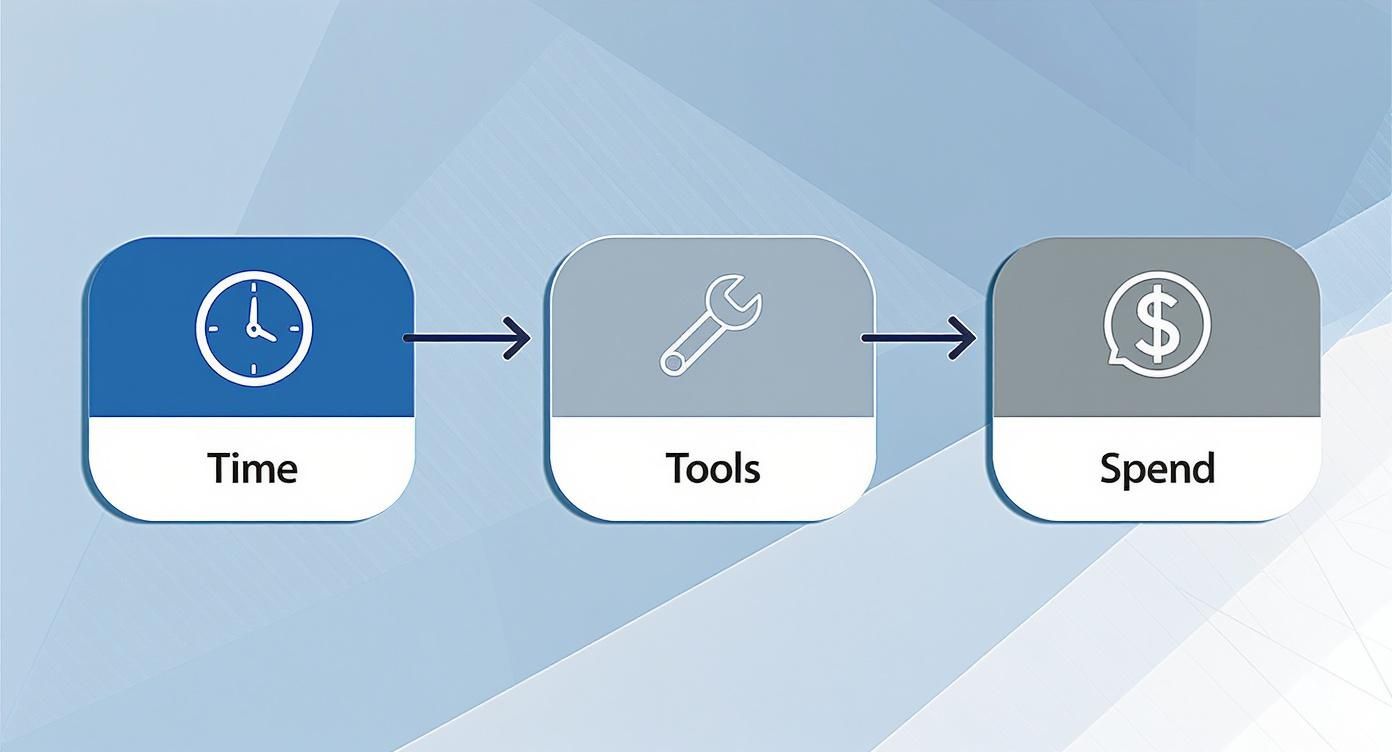
It’s a simple reminder that your total investment is a mix of your time, the tools you use, and any direct ad spend.
Assigning value to leads transforms your ROI calculation from a simple sales tracker into a sophisticated tool that measures the full impact of your social media funnel, from initial awareness to final conversion.
This approach lets you justify efforts that don’t result in immediate sales but are vital for long-term growth. When you can connect your spending to clear outcomes, you start proving the true value of your work.
Putting the ROI Formula to Work: Real-World Scenarios
Knowing the formula is one thing, but the real magic happens when you start plugging your own numbers into a social media ROI calculator. It brings everything into focus. The basic equation is simple: (Profit / Cost) x 100.
Let's break down how this works in practice with two completely different examples. First, a B2B consultant using LinkedIn, and then a social media manager running an e-commerce campaign. You'll see exactly how to adapt the formula to your own situation.
Scenario One: The LinkedIn Creator
Let's imagine a business consultant who uses LinkedIn to find clients for a high-ticket coaching program. Their strategy is purely organic—no paid ads. The investment is almost entirely their time, plus a couple of tools.
Here’s what a month of their costs might look like:
- Time Investment: They spend 20 hours creating content, engaging with their network, and doing outreach. If they value their time at $75/hour, that’s a $1,500 investment.
- Software Costs: $100 for a scheduling tool and a design app like Canva.
- Total Monthly Cost: $1,600
So, what did they get back for that $1,600? That month, their LinkedIn efforts landed them four qualified sales calls. From past experience, they know they close about half of these calls. Each new client is worth $5,000 over their lifetime.
- Leads Generated: 4 sales calls
- Clients Closed: 2
- Total Profit: 2 clients x $5,000 = $10,000
Now we run the numbers: (($10,000 Profit - $1,600 Cost) / $1,600 Cost) x 100
The final ROI for the LinkedIn creator is 425%.
That’s a powerful number. It clearly shows that their time and small software spend generated more than four times its cost in actual business value.
Scenario Two: The eCommerce Instagram Campaign
Now for a different world. Picture a social media manager running an Instagram campaign for an artisanal coffee brand. This is all about driving direct sales, so it involves ad spend and careful tracking.
The costs are much more straightforward here:
- Ad Spend: $2,000 on Instagram Story and feed ads.
- Content Creation: $500 paid to a creator for the ad visuals.
- Management Fee: A portion of the manager's retainer, which they attribute as $500 for this campaign.
- Total Campaign Cost: $3,000
They used UTM codes and the Meta Pixel to track everything, so the return was crystal clear.
- Total Revenue Generated: $7,500
- Cost of Goods Sold (COGS): The coffee itself costs money. At 40% of revenue, that's $3,000.
- Total Profit: $7,500 Revenue - $3,000 COGS = $4,500
Let's plug it all into the ROI formula: (($4,500 Profit - $3,000 Cost) / $3,000 Cost) x 100
The final ROI for the Instagram campaign is 50%.
While it's not the 425% from our first example, a 50% ROI is still a solid win. The campaign was profitable and proved to be a good investment for the brand.
As you can see, the formula is incredibly versatile. As long as you can track your costs and connect your efforts to a return—whether that’s direct sales or valued leads—you can get a clear picture of what’s working. If you want to dive deeper into tracking these outcomes, our guide on how to measure content performance is a great next step.
Actionable Ways to Boost Your Social Media ROI

Figuring out your ROI is a great start, but it’s just that—a start. The real magic happens when you use that number to make your strategy even better. Moving from just measuring to actively optimizing is what separates a decent social media presence from a great one.
This whole process kicks off with a good, hard look at your results. Your ROI calculator showed you what’s making money, but now you need to understand why. It's time to dig into which platforms, content types, and individual posts are pulling in the most valuable conversions.
Pinpoint High-Performing Content
Are your Instagram Reels driving more sales than your deep-dive LinkedIn articles? Maybe one specific ad creative is blowing all the others out of the water. Your data will show you the patterns.
Once you’ve found your winners, the next step is pretty straightforward: do more of what works.
But don't just copy and paste. Break down why that successful content connected with people. Was it the snappy hook? The clear call-to-action? The visual style? This is the kind of insight that should shape your future content calendar, making sure you’re always putting your best foot forward.
Run Strategic A/B Tests
With a solid baseline of what works, you can start experimenting. A/B testing is your secret weapon for making small tweaks that lead to big gains over time. This isn’t about throwing spaghetti at the wall; it’s about making calculated, data-backed refinements.
Try testing a few of these variables to see what really moves the needle:
- Ad Creative: Pit different images, videos, or headlines against each other. See what grabs your audience's attention.
- Audience Targeting: Play with different demographics, interests, or even lookalike audiences. You might find a whole new group of people who are cheaper to reach.
- Landing Page Experience: Where do you send people after they click? Try a couple of different landing pages to see which one does a better job of turning visitors into customers.
With social media ad spending expected to reach a massive $276.7 billion by 2025, getting the most out of every dollar is non-negotiable. So many companies throw money at ads without ever truly connecting it to sales. A/B testing is what builds that bridge. For example, if you find out your customer acquisition cost (CAC) is $30 on social media but $150 through search ads, you know exactly where to put your next budget increase. You can learn more about how to accurately link social media efforts to sales conversions on vistasocial.com.
The goal of optimization isn't just to increase your profit margin. It's about building a more efficient, predictable engine for growth, where every dollar and hour invested delivers a stronger return than the last.
Improving your results is also about working smarter, not harder. As you get busier running tests and crunching numbers, the right social media management tools can be a lifesaver, freeing up time you can spend on actual strategy. By constantly testing, learning, and refining, you’re setting yourself up to see an even better ROI report next time around.
Got Questions About Social Media ROI? We've Got Answers.
Even with a solid formula and a calculator ready to go, you're bound to have some questions. That’s perfectly normal. When you start digging into the details of ROI, a few things always come up.
Let's walk through some of the most common hurdles that pop up for creators and social media managers. Getting these sorted out is key to building a measurement process you can actually trust.
How Often Should I Be Calculating This Stuff?
Honestly, it depends on what you’re doing. For your general, day-to-day social media presence, running the numbers on a monthly basis is a great rhythm. It gives you enough data to see real trends but isn't so frequent that you're just reacting to random daily noise.
Now, if you're running a specific campaign—like a product launch or a Black Friday deal—you'll want to calculate the ROI for that project once it's wrapped up. This gives you a clean, self-contained look at how that specific initiative performed. The most important thing is to be consistent. Pick a schedule and make it a habit.
So, What’s a "Good" Social Media ROI, Anyway?
This is the big question, isn't it? But the real answer might surprise you: a "good" ROI is simply a positive one that you can improve on over time.
You might see industry reports throwing around big numbers, like an average ROI of 250%. But that figure is all over the map depending on the industry, a company's profit margins, and what they're trying to achieve.
Don't get hung up on chasing someone else's benchmark. The real goal is to beat your last number. Focus on continuous improvement. That's how you prove your strategy is getting smarter and more valuable.
If you hit a 50% ROI this quarter after getting 20% last quarter, that's a huge win. That’s the mindset that truly fuels growth.
How on Earth Do I Track ROI for My Organic Posts?
Measuring the return on organic content feels like a puzzle, but it’s definitely solvable. Since you aren't spending money on ads, your main "cost" is the value you've assigned to your time, plus any software subscriptions.
For the "return" part, you need to get creative and assign value to actions that aren't direct sales. Here's how to tackle it:
- Become a pro with UTMs: Slap UTM parameters on every single link you share organically. This is the only way to know for sure how many people are landing on your site directly from your posts.
- Assign value to your leads: Remember how we talked about giving a dollar value to an email signup or a demo request? Apply that same logic here. Every lead from organic social has a tangible value.
- Watch for brand lift: Keep an eye on your Google Search Console. If you see a spike in people searching directly for your brand name after a period of high social activity, that's your organic effort paying off.
By tracking these proxies, you can build a powerful case for your organic strategy. It proves that your content isn't just floating in the void—it's actively contributing to your bottom line.
Ready to stop guessing and start measuring? Unibox can help you streamline the outreach that turns social media engagement into booked meetings. See how our platform centralizes your conversations and automates follow-ups so you can focus on converting leads into revenue. Start your free trial.