
Human to Human Communication in a Digital World
Published on 2025-11-18
At its core, human-to-human communication is just that—dropping the corporate mask and connecting with people on a real, genuine level. It’s all about putting empathy and clarity first, leaving the jargon and stiff formalities behind. This simple shift turns a transaction into a relationship built on trust.
What Is Human to Human Communication

Think about the last time you contacted a company. Did you get a generic, automated "your request has been received" email? Or did a real person reply, saying something like, "Hey, I saw your note. Let me look into this for you and I'll be back in touch shortly"?
The first one feels cold and distant. The second one? It’s reassuring and builds instant trust. That’s the entire essence of Human to Human (H2H) communication. It isn't some groundbreaking new strategy; it’s a return to the basics of how we connect with each other. In a professional world saturated with bots and canned responses, your audience is craving that authentic human touch.
Beyond B2B and B2C
For decades, we’ve put business communication into two neat boxes: Business-to-Business (B2B) and Business-to-Consumer (B2C). The problem is, these labels create a mental block. They make us see our audience as abstract targets—faceless companies or demographic data points—instead of the actual people they are.
H2H communication shatters that illusion. It’s a powerful reminder that every business deal is signed by a person and every purchase is made by a person with their own story. This approach taps into the shared human experiences that truly drive connection. It’s a close cousin to conversational marketing, which also champions real-time dialogue and relationship-building over one-way monologues.
Let's break down the difference with a quick comparison.
Corporate-Speak vs Human to Human Communication
This table shows just how different the two approaches are in practice.
| Attribute | Corporate-Speak (B2C/B2B) | Human to Human Communication (H2H) |
|---|---|---|
| Tone | Formal, impersonal, authoritative | Authentic, approachable, empathetic |
| Language | Jargon, acronyms, buzzwords | Clear, simple, conversational |
| Goal | To inform, broadcast, or sell | To connect, help, and build trust |
| Perspective | "We are the experts." | "We're in this together." |
| Focus | Product features, company achievements | Customer problems, shared experiences |
As you can see, H2H isn't about ditching professionalism; it's about being more relatable.
Human to Human communication isn’t about being unprofessional; it’s about being relatable. It means replacing dense corporate-speak with understandable language and sharing insights from your actual experience to build credibility.
When you bring this mindset to platforms like LinkedIn, everything changes. You stop just broadcasting company wins and start sharing the lessons you learned from a failure. Instead of just pitching a service, you start a conversation to solve real problems for the real people on the other side of the screen.
This shift doesn’t just feel better—it gets far better results.
Why Your Audience Craves a Real Connection
In a world filled with endless notifications and automated messages, a genuine human voice isn't just nice to hear—it's a massive advantage. We're not built to form relationships with logos or mission statements; our brains are fundamentally wired to connect with other people. This is the simple truth behind effective human to human communication.
This drive for connection is baked into our psychology. When someone shares a relatable story, admits they messed up, or just lets their personality shine through, it triggers something powerful in us. It builds trust, creates empathy, and makes us feel like we're truly being seen. It's the difference between a real conversation over coffee and a sterile corporate press release. One feels alive, the other feels like it came off an assembly line.
And in the vast, noisy world of the internet, this need for authenticity is stronger than ever.
The Problem with Digital Overload
The sheer scale of our online world is staggering. As of early 2025, there are 5.56 billion people using the internet—that's nearly 68% of everyone on the planet. You can dive deeper into these numbers in the 2025 Global Overview Report on datareportal.com.
While that means countless opportunities to connect, it also creates an incredible amount of noise. A generic, impersonal message just gets lost in the static of marketing emails and robotic social media updates. But a real, human-to-human interaction? That cuts right through. It stands out precisely because it’s so rare, and that scarcity makes it valuable.
Your audience isn't just tired of corporate-speak; they're actively looking for an alternative. They want to see the person behind the job title, the story behind the company, and the hard-earned lessons behind the wins.
This isn’t about just being friendly. It's a strategic move. When people feel a real connection with you, they're far more open to your ideas, more forgiving when you make a mistake, and much more likely to become champions for what you do.
Building Trust by Being Real
One of the most powerful ways to connect is through what I call strategic vulnerability. This doesn't mean airing your dirty laundry online. It's about having the courage to share a lesson you learned from a professional blunder or an obstacle you had to fight to overcome.
Sharing stories like this accomplishes two huge things:
- It makes you relatable. Everyone has stumbled. Sharing your own struggles shows you’re human, just like them.
- It builds instant trust. Authenticity shows you aren't hiding behind some flawless corporate image, which makes you far more believable.
Truly connecting with your audience is the key to boosting social media engagement. When you drop the polished mask and embrace a more authentic voice, you stop just broadcasting messages and start building a real community. It’s a shift that turns your professional presence from a monologue into a powerful conversation—and those are the connections that stick.
The Core Principles of H2H Communication
Putting the idea of human-to-human communication into practice is easier than it sounds. It really just comes down to a few core principles that put genuine connection ahead of corporate polish. Once you get these right, you start creating content that doesn't just broadcast a message—it actually connects with people.
Think of these principles as your toolkit. They’re not just fluffy concepts; they're actionable guides for every single thing you post, helping you shift from simply talking at your audience to talking with them.
Authenticity Over Perfection
Authenticity is all about swapping a perfect, polished image for a real, relatable one. Let’s be honest, nobody connects with a flawless brand or a professional who’s never put a foot wrong. We connect with real people who stumble, learn, and grow. That means being open about the struggles, not just shouting about the wins.
For instance, instead of a sterile post that says, “We hit our Q3 targets!” you could tell the real story. A founder could share something like, “We finally hit our Q3 goal, and man, it was a grind. Back in July, we almost lost a huge client, and it forced us to completely tear down and rebuild our onboarding process. Here’s the painful lesson we learned…”
That kind of honesty builds instant trust. It proves you aren't hiding behind a corporate shield, which makes you far more credible and, well, human.
Empathy in Every Message
Empathy is the engine that drives H2H communication. It's about putting yourself in your audience's shoes and truly understanding their world—their problems, their frustrations, their goals. Without it, your message is just background noise.
Just think of a typical customer service chat. A canned response like, "We apologize for the inconvenience and have escalated your ticket," feels cold and dismissive. An empathetic one sounds completely different: "I can see how frustrating this must be, especially with your deadline coming up. I’ve personally looked into this for you, and here’s what I’m doing right now to get it fixed."
The second one works because it validates their feelings and builds a bridge. This is how you start building real trust.
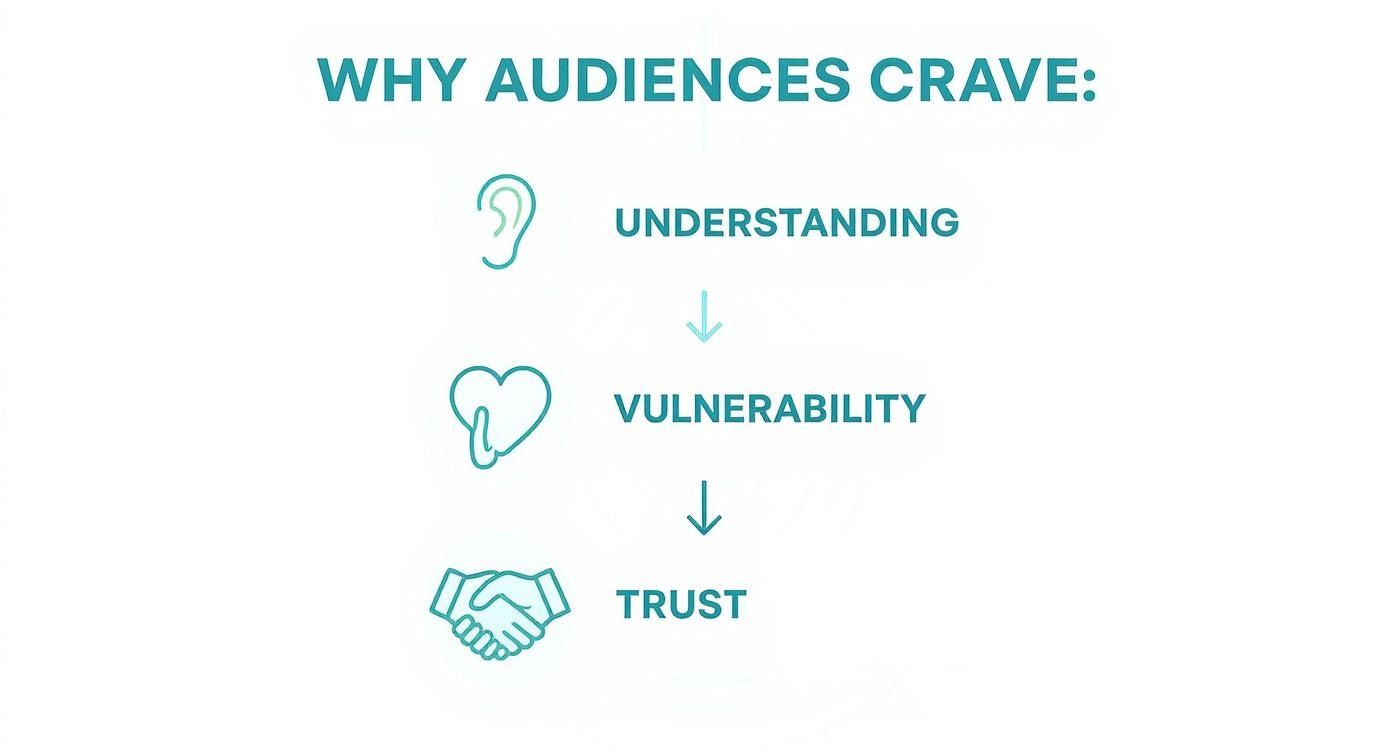
As you can see, trust doesn't just happen. It’s the result of someone feeling truly understood after you’ve shown a bit of genuine vulnerability.
Clarity Over Jargon
Your expertise is a huge asset, but it’s worthless if no one can understand what you're saying. H2H communication is built on simple, clear language, not industry jargon and acronyms. The aim is to be accessible to everyone, not just a small circle of insiders.
Your goal is not to sound smart; it's to be understood. Clear communication is a sign of respect for your audience’s time and attention.
So instead of saying, "We will leverage synergistic paradigms to optimize user-centric workflows," just say: "We're going to combine our team's strengths to make our software easier for you to use." One is corporate-speak, the other is just helpful. Having solid brand voice guidelines is a great way to keep everyone on your team speaking the same clear language.
Storytelling Over Statistics
Facts and data are great for informing, but stories are what people actually remember. Our brains are hardwired for narrative. A good story can take dry data and wrap it in emotion, making your point far more powerful and memorable.
Don't just state that your company grew by 300%. Tell the story of your very first customer—the one who took a chance on your idea when it was just a sketch on a napkin. That personal tale will forge a connection much deeper than any statistic ever could.
Putting H2H Into Practice on LinkedIn
Alright, so we've talked about the theory behind human to human communication. Now for the fun part: actually doing it on LinkedIn. This is where the magic happens, and it's less about a total overhaul and more about making small, deliberate shifts in how you show up.
The goal isn't to invent a new online persona. It's about letting your real one out. Let’s walk through some practical ways to apply H2H principles, starting with the first thing everyone sees: your profile.
Start With Your Profile
Think of your LinkedIn profile as your digital handshake. It’s your first impression, and you want it to feel like there's a real, interesting person on the other side of the screen.
Your Profile Picture: Ditch the stiff, corporate headshot that looks like it was taken under fluorescent lights. Go for a photo where you seem approachable and friendly—a real smile is your best asset. This isn’t about being unprofessional; it's about being human.
Your Bio: This is a big one. Write your "About" section in the first person ("I love figuring out...") instead of the third person ("Jane is an expert in..."). That simple switch instantly makes it feel like you're talking to the reader, not at them.
Your Headline: Your headline is prime real estate. Don't just settle for your job title. Add a splash of personality or purpose. Instead of "Marketing Director," you could try "Marketing Director | Helping Tech Startups Find Their Voice." See the difference?
These are tiny changes, but they send a powerful signal: you're here to connect, not just to list your accomplishments.
A great H2H profile invites conversation. It should read less like a resume and more like an introduction to a person someone would genuinely want to grab coffee with.
Transform Your Content From Corporate to Human
Now, let's get into your posts. This is where you can truly turn bland corporate updates into engaging human to human communication. The key is to stop broadcasting and start conversing.
This shift is all about using effective audience engagement strategies that create a genuine dialogue instead of a one-way announcement.
H2H Post Transformation Examples
It's one thing to talk about it, but it's another to see it in action. The table below shows a few side-by-side examples of how a simple H2H tweak can completely change the tone and effectiveness of a post.
| Post Type | Before (Corporate-Speak) | After (Human to Human) |
|---|---|---|
| Sharing a Personal Insight | "This quarter, our team optimized workflows, resulting in a 15% increase in productivity. Strategic implementation of new software was key to this success." | "I used to dread our Monday morning meetings. A few weeks ago, I tried a simple experiment that completely changed the vibe, and our team's output is already up 15%. Here's the one small tweak that made all the difference..." |
| Highlighting a Team Member | "Congratulations to Sarah for her promotion to Senior Project Manager. Her contributions have been invaluable to the department's objectives." | "I'm so thrilled to announce that Sarah is now our Senior Project Manager! I'll never forget when she single-handedly saved the XYZ project on a Friday night. She's a rockstar, and we’re lucky to have her. Join me in congratulating her!" |
| Asking a Question | "What are your thoughts on the future of AI in marketing?" | "I just read a wild statistic that 73% of marketers feel overwhelmed by AI. I'm feeling it too. What's one AI tool that's actually made your life easier, not more complicated?" |
Notice the difference? The "After" versions tell relatable stories, spark curiosity, and show genuine emotion. They're specific, vulnerable, and grounded in real problems, making it so much easier for people to jump in and start a real conversation.
By adopting these simple frameworks, you can start building stronger, more authentic connections on LinkedIn today.
Building a Sustainable H2H Content Workflow
Let's be real: trying to be "authentically human" online can feel like a full-time job. You want to build genuine connections, but you're already stretched thin. The good news is, you don’t have to choose between consistency and authenticity.
The secret isn't about working harder; it’s about being smarter with your energy. You need a system that separates your unique, human genius from the more repetitive tasks. By focusing your limited time on what only you can do—sharing your core idea—you can build a workflow that doesn’t burn you out.
It boils down to a simple, three-step process.
Step 1: Capture the Raw Idea
This is the most important part, and it has to be 100% you. Your personal stories, your contrarian opinions, your hard-won insights—that's the magic. Don't censor yourself or worry about sounding polished. Just get the thought out of your head.
Think about how the top creators do it. Many just hit record on their phone and talk while they're walking the dog or driving. It's a quick, unfiltered brain dump. This raw material is the soul of your content; it’s the one thing you can't fake, delegate, or automate.
Step 2: Structure and Refine
Okay, you’ve captured the spark. Now you can bring in some help. This is where a virtual assistant or a smart AI tool can take over the grunt work. Their job is to take your messy, brilliant thoughts and give them some structure.
This part of the process can handle things like:
- Transcribing your voice note.
- Organizing your key points into a logical flow.
- Cleaning up the grammar and sentence structure for clarity.
- Suggesting formatting like bullet points to make it easy to read.
This step is a massive time-saver. It turns that stream-of-consciousness recording into a solid first draft. If you want to dive deeper into this system, you can learn more about building an effective content creation workflow.
Step 3: Final Review and Personalize
The draft comes back to you for the final, critical touch. Read it over and ask yourself, "Does this sound like me?" Now's the time to tweak a few words, add a small personal detail, or adjust a sentence until it feels just right.
Your final check is non-negotiable. This is where you inject your unique personality back into the text. It ensures the tone is perfect and the message is truly yours, keeping the content authentic even with help behind the scenes.
This workflow protects your most valuable asset: your unique human perspective. By separating your core insight from the assembly-line tasks, you can finally create genuine human-to-human communication on a consistent schedule, without draining your creative battery.
Here is the rewritten section, designed to sound completely human-written and natural.
How to Measure the Real Impact of Your H2H Strategy
So, how do you prove that a "softer" way of talking actually leads to hard results? If you're only looking at traditional metrics like likes and follower counts, you're missing the point of human-to-human communication. The real magic isn't in how many people you reach, but how deeply you connect with them.
To see what's really happening, you have to look past the surface. The goal is to spot the signals that show you're building genuine relationships and creating real business opportunities. It’s a mindset shift—moving away from vanity metrics and toward measuring meaningful interactions.
Tracking What Actually Matters
Stop obsessing over likes. Instead, start paying attention to the metrics that reflect genuine connection and influence. These are the numbers that prove your H2H strategy is paying off.
Here are a few things I always track:
- Comment Sentiment: Look at the type of comments you're getting. Are they just one-word replies like "great post," or are people sharing their own stories and starting real discussions? That's the good stuff.
- Inbound DMs from Ideal Contacts: How many people you actually want to talk to are sliding into your DMs? A single message that says, "Your post really resonated with me," is worth a hundred generic likes.
- Quality of New Connections: Who is sending you connection requests? If you're attracting peers, potential clients, and industry leaders you respect, you know you're on the right track.
The key to tracking H2H success is to measure the conversations that spark opportunities. Keep a simple log of every valuable DM, introduction, or sales call that started from a post. You'll quickly see the direct line between being authentic and getting results.
Got Questions About H2H? Let's Clear Things Up.
Switching to a more human way of talking can feel a bit strange, especially if you’ve spent your career in a buttoned-up corporate world. It’s a common feeling. Let's walk through some of the questions that pop up when people start making this shift.
Is This "Human" Style Okay for Serious Industries?
You bet it is. In fact, it’s a game-changer. Human-to-human communication isn't about being unprofessional—it’s about being real and easy to understand. Think about it: in fields like finance or law, where trust is everything, this approach helps you build it faster than anyone else.
It's not about cracking jokes in a legal brief. It’s about ditching the dense jargon for plain English and sharing what you know from your own experience. You’re not a faceless logo; you're a credible expert people can actually connect with.
Can I Still Sound Like "Me" if an Assistant or AI Helps Write My Content?
Absolutely, because the core of the content has to come from you. The real magic—that unique story, that contrarian opinion, that hard-won insight—can only come from your brain. That's the part you can't hand off.
Your assistant or an AI tool is there to do the heavy lifting: structuring your thoughts and polishing them into a first draft.
But the final pass is all you. Read it out loud. Does it sound like something you'd actually say to a colleague over coffee? Tweak it until every word feels right. That final, personal touch is where authenticity lives.
Won't Being Vulnerable Make Me Look Unprofessional?
There's a huge difference between smart, strategic vulnerability and just oversharing. Talking about a tough project you navigated or a lesson you learned from a mistake doesn't make you look weak. It shows you've been in the trenches and came out wiser.
The key is to share stories that genuinely help your audience. This is what builds deep credibility and trust, which are the cornerstones of being a professional today. It proves that being human isn't a liability; it's your greatest strength.
Ready to share your real ideas without spending hours writing? autoghostwriter is designed to help you turn your expertise into compelling LinkedIn posts that build genuine connections. Find your voice and start building better connections today.