how to write author biography: quick guide to selling books
Published on 2025-12-04
Crafting an author biography is a unique balancing act. You need to blend your professional credentials and writing accomplishments with just the right amount of personal flair, all wrapped up in a compelling, third-person story. The real secret is creating a few different versions—a short one for Twitter, a longer one for your website—to make sure you're always introducing yourself, building credibility, and connecting with the right people.
Your Author Bio Is a Powerful Marketing Tool

Let's be honest. Does anyone really enjoy being asked for an author bio? It can send even the most seasoned writer into a mild panic. It feels self-promotional and awkward, and it's tempting to just dash something off and forget about it.
But what if you stopped thinking of it as a chore and started seeing it as one of your sharpest marketing tools?
Your author bio is often the first real introduction a reader, agent, or publisher has to you. It's the handshake before the conversation, that brief moment where you can build trust and spark their curiosity. A great bio doesn't just list facts; it tells a story—your story.
Why Your Bio Matters More Than You Think
A strong author bio works tirelessly for you behind the scenes. It's a critical piece of your professional toolkit, turning casual browsers into dedicated fans and industry contacts into real partners.
Here’s what a great bio really does:
- Builds Credibility: It’s your chance to show off your expertise, awards, and relevant experience. This gives agents, publishers, and readers a solid reason to trust your voice.
- Creates a Human Connection: A small dose of personality—a quirky hobby, a mention of your pets, a glimpse into your life—makes you relatable and much more memorable.
- Sells More Books: By establishing both authority and a genuine connection, your bio can be the final nudge a potential reader needs to hit that "buy" button.
Think about it: the biography and memoir publishing industry is booming, making up a huge share of the 2.2 billion books sold worldwide each year. Readers are hungry for authentic stories, and yours is the first one they’ll encounter.
Your author bio is your professional handshake, your elevator pitch, and your personal brand story all rolled into one. It’s the bridge between your name on the cover and the reader holding your book.
One Size Does Not Fit All
One of the biggest mistakes writers make is thinking a single bio will work everywhere. It won't. The punchy, 50-word blurb that fits perfectly on your book jacket will feel thin and incomplete on your website's detailed "About" page. For some fantastic pointers on this, check out this guide on how to write an author bio that sells books.
You'll need a handful of bios ready to go, each shaped for a different context—from a short-and-sweet social media profile to a more formal speaker introduction. If you're looking to build out your web presence, our guide on creating a compelling "About the Author" page is the perfect next step.
Let's get started on crafting a bio that works just as hard as you do.
Gathering the Raw Materials for Your Story
Before you even think about writing your bio, you need to know what you’re working with. Staring at a blank page is the fastest way to get stuck, so let's start by taking inventory instead.
Think of this first step as creating a "master document"—a private brainstorming file where you dump every possible ingredient for your future bios. This isn't for public consumption; it's your personal treasure chest of facts, accomplishments, and quirks you can pull from anytime you need to write a new bio.
Catalog Your Writing Accomplishments
Let's start with the hard evidence of your writing life. This is where you list everything that proves you’re a writer in your field. Don't hold back or get modest—this is just for you. Get it all down on paper.
Your list of accomplishments should include things like:
- Publications: Every single thing you've had published. Books, short stories, articles, even that poem in your college literary journal. Note the publisher or publication, too.
- Awards and Recognition: Did you win an award? Make a bestseller list? Were you a finalist for a prize? It all counts, even that local contest you won years ago.
- Residencies and Fellowships: Note any prestigious programs or workshops you've been a part of.
- Positive Reviews or Endorsements: Pull out a few powerful quotes from respected authors, trade publications, or even influential book bloggers.
This list forms the backbone of your credibility. You won't use it all at once, but you'll pick and choose from it later.
Document Your Professional Credentials
Next up, what gives you the authority to write what you write? Think about the experiences that make you uniquely qualified to tell your stories. This is a huge deal for non-fiction authors, but it can add incredible depth for fiction writers, too.
For instance, a thriller author who was a forensic analyst for 10 years has instant credibility. A romance author with a Ph.D. in psychology brings a fascinating perspective. Think about your day job (past or present), your education, or any specialized skills that feed into your writing.
The key is relevance. A degree in marine biology is a fantastic detail for an author writing sci-fi set in an aquatic world, but it might feel out of place for a historical romance author. Always connect your credentials back to your writing.
Look at how established authors do this. Neil Gaiman's Wikipedia page, for example, immediately lists his major works, showing his authority and range right from the start.
This simple list of titles tells you everything you need to know about his impact and establishes him as a master of his craft without any fluff.
Uncover Unique Personal Details
Okay, now for the fun part. It’s time to add the details that make you sound like a real person, not just a list of achievements. This is what helps readers feel a genuine connection with you.
Your goal is to find one or two memorable, authentic tidbits that stick in people's minds.
Brainstorm a list of things that make you you:
- Hobbies and Passions: Do you collect vintage typewriters? Practice archery? Bake ridiculously complicated cakes?
- Life Experiences: Have you traveled the world? Lived on a boat? Worked a truly bizarre job before becoming a writer?
- Location: Where you live can be a huge part of your story, especially if it ties into your books (e.g., "She writes from a small cabin in the Alaskan wilderness").
- Quirks: Don't be afraid to be a little playful. Mentioning you live with "two mischievous cats" or are on a "lifelong quest for the perfect cup of coffee" adds a warm, human touch.
Once you have this master document brimming with accomplishments, credentials, and personal details, writing an author bio stops being a struggle. It becomes a simple matter of choosing the right pieces for the right audience.
Tailoring Your Bio for Different Platforms
It’s tempting to write one author bio and just copy-paste it everywhere, but that’s a huge missed opportunity. Think about it: the person reading your bio on a professional networking site like LinkedIn is looking for something very different from a fan who just finished your book and flipped to the back jacket.
One size definitely does not fit all here.
The key is to think like a marketer and adapt your message to the medium. Your website, social media profiles, book jacket, and speaker introductions all have different audiences and unwritten rules. A truly effective author bio isn't a single document—it's a flexible set of introductions, each perfectly suited for where it will appear.
This approach ensures you make the right first impression, every single time.
The Author Website About Page
Your website’s "About" page is your home turf. It’s where readers, media contacts, and event organizers will land when they want the full story. This is the one place where you have the space to go deeper.
While most bios are an exercise in brevity, here you can stretch out a bit. Aim for something between 150 and 300 words. The goal isn’t just to list facts; it’s to tell a compelling story.
- Share your "why." What was the spark that ignited your first novel? Why are you so passionate about your non-fiction subject? This is where you connect with people.
- Show, don’t just tell. Instead of saying you're a "dedicated researcher," mention the decade you spent digging through historical archives. Concrete details bring your expertise to life.
- Let your voice shine. If you write funny books, your bio should make people smile. If you write serious academic works, the tone should be authoritative and professional.
This is your best chance to turn a casual visitor into a devoted fan by building a genuine connection.
Your Social Media Profiles
On social media, you have seconds—if that—to make an impact. Platforms like X (formerly Twitter) and Instagram have tight character limits, so you have to distill your entire author identity into a punchy one-liner.
Think of it as your elevator pitch. It needs to be quick, clear, and intriguing.
The different pieces of your story—your accomplishments, credentials, and personal details—are like building blocks. You'll mix and match them to fit the platform.
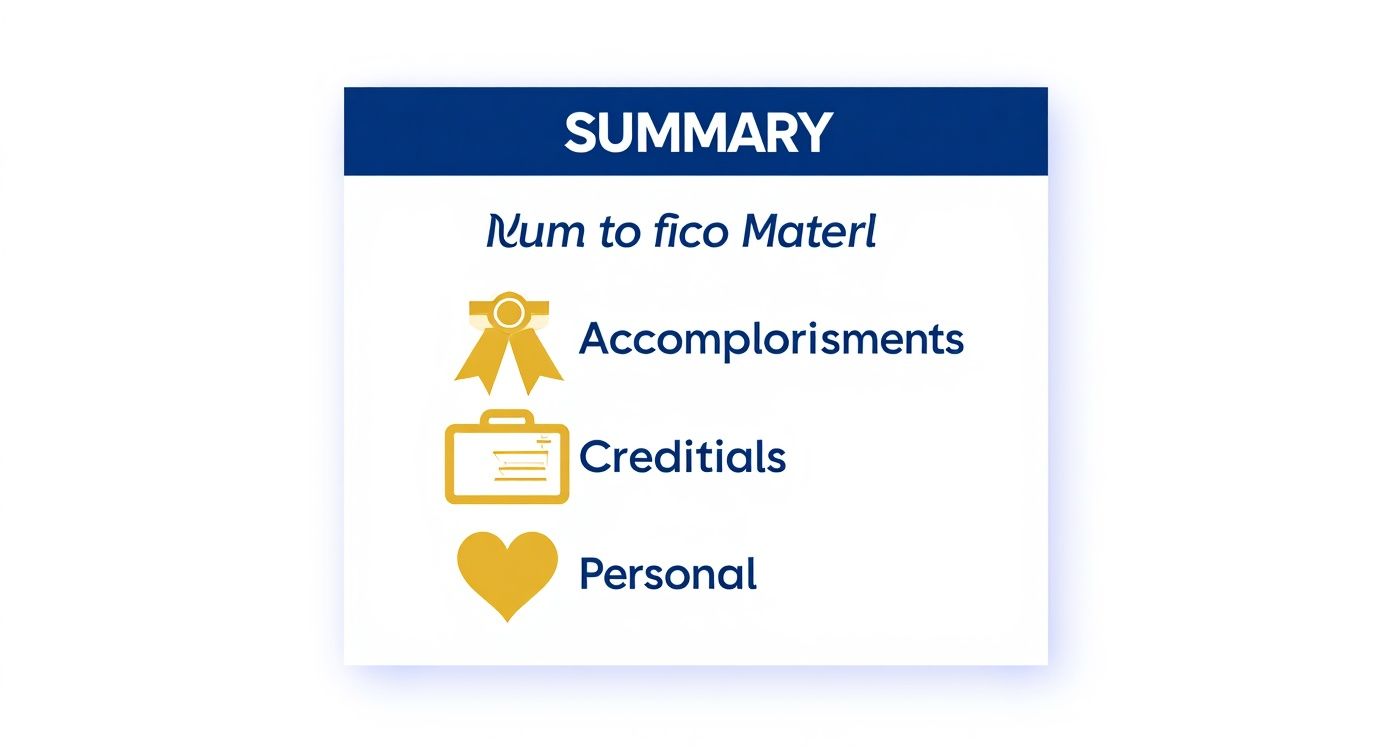
Lead with what matters most to that specific audience. Are you a "NYT Bestselling Author" or a "Fantasy writer & cat enthusiast"? On a professional platform, the bestseller tag is gold. On a more personal platform like Instagram, the cat-loving fantasy writer might attract more of your ideal readers.
A great social bio also tells people what to do next. Don't just leave them hanging! Add a clear call to action (CTA) to turn your profile into a real marketing tool.
- Link to your newest book.
- Point them to your newsletter sign-up page.
- Ask them to follow you on another platform.
Author Bio Requirements by Platform
To make this easier, here’s a quick-reference guide that breaks down the different expectations for an author bio across the most common professional platforms. Think of this as your cheat sheet for crafting the perfect intro, no matter where you are.
| Platform | Ideal Length (Words) | Tone/Style | Key Elements to Include |
|---|---|---|---|
| Author Website | 150-300+ | Personal, engaging, brand-aligned | Your writing journey ("why"), detailed credentials, personal story, multiple CTAs (newsletter, social, books). |
| Book Jacket | 50-100 | Professional, concise, genre-relevant | Name, genre, key credibility point (award, bestseller), brief personal detail, connection to the book's topic. |
| Social Media | 25-50 | Punchy, personality-driven, quick | Hook (e.g., "Author of..."), keywords for your niche, a single strong call to action (CTA), a touch of personality. |
| Speaker Bio | 75-150 | Authoritative, expert-focused | Professional credentials, relevant expertise, speaking experience, publications, tailored to the event's topic. |
This table should help you quickly tailor your core information for any situation, ensuring you always put your best foot forward and connect with the right audience in the right way.
The Book Jacket Bio
This is the classic, and it’s arguably the most important bio you'll write. It sits right on the book itself, and its main job is to reassure the reader they made a good choice. It has to be tight, professional, and laser-focused on the book they’re holding.
You’ve got about 50 to 100 words. No fluff allowed.
Every single word needs to earn its place. A solid formula looks something like this:
- Who you are and what you write: "Jane Doe writes historical thrillers."
- Why they should trust you: Mention a major award, bestseller status, or a key publication.
- Your connection to the genre: If you write sci-fi, maybe you have a background in astrophysics. Writing a cookbook? Mention your culinary degree.
- A quick personal touch: "She lives in Seattle with her dog, Winston."
If you want to see more structures and examples you can adapt, this guide on a personal bio template is a fantastic resource.
The Professional Speaker Bio
When you’re about to be introduced at a conference, on a podcast, or during a literary festival, your bio needs to scream "expert." This version is less about your quirky hobbies and all about establishing why you are the authority on the topic at hand.
Shoot for around 75-150 words, and make sure it highlights your most relevant accomplishments.
- Lean into your credentials. This is the time to feature your professional background, education, and any other experience that proves your expertise.
- Mention speaking gigs. Have you given a keynote or appeared on notable panels before? Add it in—it adds a ton of weight.
- Customize it for the event. If you're speaking at a mystery writers' conference, your bio should spotlight your work in that genre, even if you also write poetry.
Remember, the event organizer will probably read this word-for-word to introduce you, so write it for them. Keep it in the third person and make it easy for them to confidently present you as the expert they invited.
Writing About Yourself in the Third Person
Writing about yourself in the third person can feel weird. Let's be honest, using "he," "she," or "they" instead of "I" is an odd mental shift for most of us. It’s like being the narrator of your own story, which doesn't come naturally.
But there’s a very good reason this is the gold standard for a professional author bio.
This simple perspective change immediately builds a sense of authority and credibility. It takes your bio from a personal journal entry and turns it into a polished, professional statement. More practically, it makes the text ready to be lifted and used by anyone—media outlets, event organizers, reviewers, or booksellers who need to copy and paste your info on the fly.
From "I" to "Pro"
Making the switch from first-person to third-person is about more than just changing a few pronouns. It's about adjusting your entire tone. You want to own your accomplishments with quiet confidence, not come across as stiff or arrogant. Think of it as framing your achievements as established facts, not just personal claims.
Let's look at a quick before-and-after to see what I mean.
First-Person Draft (The "Before"):
"I wrote my first novel, The Crimson River, after I spent a decade working as a journalist. I've always been fascinated by true crime, and I try to bring that realism to my stories. I live in Denver with my golden retriever, Gus."
Third-Person Revision (The "After"):
"Jane Doe is the author of the thriller The Crimson River. Drawing on her decade of experience as an investigative journalist, she crafts stories grounded in chilling realism. Jane lives in Denver with her golden retriever, Gus."
See the difference? The second version is instantly more professional. It’s tight, authoritative, and ready for a press kit or book jacket. This is a small but critical step in crafting a bio that really works for you.
Why This Perspective Is a Game-Changer
Writing in the third person does something psychologically helpful, too. It creates a bit of distance between you and your list of achievements, which is a lifesaver if you struggle with imposter syndrome. It allows you to state your credentials as simple, objective truths. Suddenly, it feels easier to talk about your successes without feeling like you're bragging.
Striking the right tone is everything. If you're looking for more guidance on this, our guide on how to find your writing voice has some great tips for sounding like yourself while still maintaining a professional edge. This skill is becoming even more important as reader tastes evolve. Recent analysis shows memoir sales are projected to grow by 15-20% annually, fueled by readers hungry for authentic stories from diverse voices.
A Few Tricks to Make the Switch Easier
If you’re still cringing at the thought of writing "she won..." or "he is an expert in...", try these techniques. They’ll help you get past the initial awkwardness.
- Pretend You're Being Interviewed. Imagine a journalist is asking you questions about your career. Jot down your answers as if they were quoting you, then weave those quotes into a narrative.
- Stick to the Facts. Start by simply listing your accomplishments. "Author of [Book Title]." "Winner of [Award]." "Previously worked as a [Job Title]." This strips the emotion out of it and gives you a factual skeleton to build from.
- Study Your Heroes. Pull up the bios of authors you admire in your genre. How do they do it? Notice their sentence structure and the details they include. Don't plagiarize, but absolutely use their work as a model.
- Read It Out Loud. Once you have a draft, read it to yourself. Does it sound like a proper introduction you'd hear at a literary festival? Hearing it spoken can instantly reveal any clunky or unnatural phrasing.
This isn't about creating a fake persona. It's about presenting your professional self in the format the publishing world expects and understands. Once you get the hang of it, you'll find it makes every other aspect of your author marketing much, much easier.
Avoiding Common Author Bio Mistakes

Crafting a killer author bio is the last mile of presenting your work. But even seasoned writers can fall into a few traps that weaken their professional image. These little missteps can make a bio feel unfocused, unprofessional, or just plain ineffective.
Think of this part of the process as your final polish. By dodging these common errors, you can be sure your bio works as hard as you do, connecting you with the right readers, agents, and publishers. The goal is to create an introduction that’s as sharp and deliberate as your writing itself.
The Humblebrag and the Oversell
Walking the line between confidence and humility is tough. I've seen countless authors swing too far one way or the other, either downplaying their successes or puffing up their credentials. Both can backfire.
The overly humble approach often sounds like this:
“Jane Doe dabbles in writing and was lucky enough to have her short story published in a small online journal. She hopes to one day finish her novel.”
This bio just doesn't inspire confidence. It makes the author sound like a hobbyist, not a professional. On the flip side, the oversell can be just as much of a turn-off.
“A literary genius, John Doe is the most important new voice in modern fiction. His unparalleled debut novel is set to revolutionize the genre.”
This comes across as arrogant and, frankly, unbelievable. The sweet spot is to state your achievements as facts, without apology or exaggeration. Just present your credentials and let them speak for themselves.
Forgetting Who Your Audience Is
One of the biggest mistakes is packing your bio with details that, while meaningful to you, are totally irrelevant to your reader. Sure, your expertise as a certified public accountant is a huge asset for a book on small business finance, but it feels completely out of place for a high-fantasy series.
You have to ask yourself: does this detail build credibility or connection for this specific book or genre?
Here are a few ways this goes wrong:
- The Hobby Hoarder: "She enjoys rock climbing, artisanal cheese-making, interpretive dance, and collecting 18th-century spoons." It's a laundry list. Pick one interesting, relatable detail that adds color.
- The Overly Personal Share: "After a messy divorce, he found solace in writing..." Stick to professional or light personal details. Your bio is a marketing tool, not a therapy session.
- The Credential Dump: "She holds a BA in History, an MA in English, a PhD in Comparative Literature, and a certificate in grant writing." Unless every single degree is directly relevant, just pick the most impressive or pertinent one.
Your bio’s job is to build a bridge to the reader. Every sentence should either establish your authority as a writer or create a relatable human connection. If a detail does neither, it's just noise.
The Outdated and Lifeless Bio
Your author bio isn't a "set it and forget it" document. It’s a living part of your professional brand that needs regular check-ups. An outdated bio can send the wrong message, suggesting you're no longer active in your field.
I recommend setting a calendar reminder to review your bio every six to twelve months. Published something new? Won an award? Gained a significant credential? Get it in there.
Another pitfall is a bio that just feels generic, completely lacking in personality. This often happens when you focus only on credentials. Don't forget to add that one small, humanizing detail that makes you memorable—your love for classic films, your cat who "helps" you write, or your ongoing quest for the perfect espresso.
The Dead End with No Call to Action
This is probably the most common marketing mistake of all: forgetting to tell the reader what to do next. Your bio piques their interest, but a call to action (CTA) is what captures it. After someone reads about you, they should have a clear next step.
Leaving out a CTA is like having a great conversation and then just walking away without swapping numbers. You made a connection but gave them no way to continue it.
Make sure your website, speaker, and social media bios all include a simple, direct instruction. This could be anything from:
- "Visit her website at [YourWebsite.com] to sign up for her newsletter."
- "Follow him on X @[YourHandle] for writing updates."
- "Her new book, [Book Title], is available now wherever books are sold."
This one small addition transforms your bio from a static summary into an active marketing tool. It invites readers deeper into your world, turning a moment of interest into a potential long-term relationship.
Your Final Author Bio Checklist
Before you hit “publish,” it’s time for one last quality check. A great author bio doesn’t just happen—it’s the result of thoughtful work and revision. Think of this as your pre-flight inspection before sending your professional story out into the world.
This quick checklist will help you catch any last-minute mistakes. Run each version of your bio through these questions to make sure it’s polished, professional, and ready to make a great impression.
The Foundational Checks
First, let's nail the basics. These are the non-negotiable elements of any solid author bio. Getting these right sets the stage for everything else.
- Is it in the third person? Unless you’re writing for a very informal, first-person platform, your bio should always use "she," "he," or "they." This is the industry standard and makes it easy for event organizers or media to copy and paste.
- Does it fit the required length? A 200-word bio is useless for a platform with a 280-character limit, like X (formerly Twitter). Double-check that you’ve tailored the length for the specific book jacket, website, or social profile.
- Does it open with your most important credential? Start with a bang. Whether it’s your name and genre, a major award, or your bestseller status, that first sentence needs to establish your credibility immediately.
Refining the Tone and Message
With the structure solid, it’s time to zoom in on the voice. This is where your bio goes from a simple list of facts to a compelling story that connects with your ideal reader.
Your bio is more than just a career summary; it’s an invitation. It should give readers a reason to trust you and a glimpse of the person behind the books, encouraging them to take that next step.
Ask yourself these questions to sharpen the message:
- Does the tone match your brand? If you write laugh-out-loud comedies, a stiff, academic bio will feel completely off. Make sure the voice in your bio aligns with the experience you promise in your books.
- Does it have a clear call to action (CTA)? Don't leave your reader wondering what to do next. Point them toward your website, newsletter, or social media. A bio without a CTA is just a missed opportunity.
- Is every detail relevant? Does your past life as an accountant really matter for your high-fantasy series? If a detail doesn't build authority or create a meaningful connection, it’s probably just noise. Cut it.
The Final Polish
Okay, one last look. This is where you make sure your bio is technically flawless. Nothing undermines your professionalism faster than a typo.
- Read it out loud. This is the single best way to catch awkward phrasing and clunky sentences that your eyes might have missed.
- Use a grammar checker. Run your text through a tool like Grammarly or ProWritingAid to catch any sneaky errors.
- Get a fresh pair of eyes on it. Ask a friend or a fellow writer to give it one last proofread. After reading it yourself a dozen times, you become blind to your own mistakes.
Once you’ve gone through these steps, your bio is ready. You’ve just created a powerful tool that will work for you long after a reader has finished your book.
Answering Your Top Author Bio Questions
It's one thing to have a plan, but when you actually sit down to write about yourself, a bunch of practical questions always seem to come up. Let's tackle some of the most common ones I hear from authors so you can get your bio polished and out into the world.
How Often Should I Update My Bio?
Think of your author bio as a living document, not a "set it and forget it" task. A good rule of thumb is to give it a quick review every 6 to 12 months. I personally pop a reminder in my calendar so it doesn't fall off the radar.
That said, you should update it immediately after any big professional win. Don't wait. Jump on it as soon as you:
- Publish a new book
- Hit a bestseller list or win an award
- Shift your writing focus or dive into a new genre
- Earn a new degree or certification relevant to your work
Keeping your bio fresh shows people you’re an active, engaged professional, not someone whose career peaked five years ago.
Can I Let My Personality Shine Through?
Please do! A bio that's all business and no personality is a surefire way to be forgotten. The trick is to let your voice come through in a way that feels authentic to your author brand while still being professional.
You don't need much. A single, well-placed detail can do all the heavy lifting. Mentioning you live with "a mischievous cat who moonlights as an editor" or that you're on a "lifelong quest for the perfect espresso" makes you instantly more human and relatable.
Your goal here is connection. Give readers a peek at the real person behind the stories, but keep it brief and make sure it fits the overall persona you're building.
What if I Don't Have Any Publishing Credits Yet?
This is probably the biggest hang-up for new writers, but a lack of bylines doesn't mean you can't have a killer bio. The secret is to stop focusing on what you haven't done and start highlighting what you have.
Lean into your life experience, your expertise, or the deep passion that fuels your writing. Frame your background as a unique asset. For instance:
"Drawing on fifteen years as a trial lawyer, John Smith writes legal thrillers that explore the dark side of justice."
See? That sentence immediately builds authority and hooks the reader. It shifts the entire conversation from your publication history to your lived experience, which is far more interesting anyway.
Ready to build your brand and connect with more readers? Unibox can help you streamline your outreach on LinkedIn and email, so you can focus on the conversations that matter. Learn how to grow your author platform at https://tryunibox.com.